

 English
 русский
 عربى
عربىSmall-batch wineries often struggle with oxidation when harvest yields or fermentation volumes don't perfectly match tank capacity. Our Variable Capacity Wine Fermentation Tank features a floating lid...
READ MORE
Wine Fermentation Tank Guide: Types, Sizing, Materials & Buying Checklist | YME Equipment
Content
- 1 What a Wine Fermentation Tank Really Does
- 2 Five Tank Designs and Where Each One Fits
- 3 Red Wine: Let the Tank Do the Cap Work
- 4 Materials and Finish: Where Quality Shows Up First
- 5 Sizing and Cooling: Do the Math Before the Quote
- 6 Cider, Fruit Wine and Small Batches
- 7 A Six-Point Checklist Before You Sign
- 8 Work With a Manufacturer That Builds the Whole Line
Walk into any working cellar during harvest and you can hear a tank problem before you see one: a pump-over pump running dry because the fermenter was sized without cap space, or a chiller chasing a must that climbed five degrees overnight because the jacket was too small for the batch. Failures like these rarely come from winemaking skill. They come from equipment choices made months earlier.
A wine fermentation tank is not just a holding vessel. It is the instrument that controls temperature, oxygen exposure, solids contact and hygiene during the most reactive 5 to 15 days of your entire process. Get the tank right and fermentation becomes predictable; get it wrong and no later step can fully repair the damage. This guide breaks down tank types, materials, sizing math and the buying checks that separate a sound investment from an expensive mistake.
What a Wine Fermentation Tank Really Does
Four variables decide fermentation quality — temperature, oxygen, cap contact and cleanliness — and the tank is the only piece of equipment that touches all four at once.
Temperature is the big one. Yeast converts sugar into alcohol and heat, and in a large vessel at peak activity an uncooled red must can overshoot 35°C within 24 to 48 hours — hot enough to stress the yeast, drive off delicate aromas and open the door to volatile acidity. White musts are even more sensitive, with ideal ranges around 12-18°C, versus 24-30°C for most reds.
- Temperature control: dimple or half-pipe jackets on the sidewall (and ideally the cone) hold the setpoint, while a PT100 probe and controller keep the band within roughly 0.5°C.
- Oxygen management: a closed, gasketed top lets CO2 from fermentation form a protective blanket, and sample valves let you taste without ever opening the tank.
- Cap contact: on reds, the floating cap of skins must be wetted one to three times a day by pump-over, punch-down or rack-and-return, or it dries out and acetobacter moves in.
- Hygiene: sanitary welds, smooth interior surfaces and CIP spray coverage decide whether the tank rinses clean in 30 minutes or becomes a chronic microbiology risk.
The same logic applies well beyond grapes. This overview of what a fermentation tank actually does across beer, cider and other beverages shows the shared principles — and the wine-specific details below are where they get interesting.
Five Tank Designs and Where Each One Fits
There is no single "best" wine fermentation tank — the right design depends on grape type, batch size and how you manage extraction. The table below summarizes the five designs wineries most often specify.
| Tank Type | Best Suited For | Signature Feature | Key Consideration |
|---|---|---|---|
| Open-top fermenter | Small red batches, punch-down work | Full physical access to the cap | Higher oxidation and contamination risk |
| Closed jacketed tank | Whites, rosés, extended lees work | Dimple jacket plus sealed CO2 blanket | Needs verified CIP spray coverage |
| Variable capacity tank | Cellars with shifting harvest volumes | Floating lid with inflatable seal | Seal inspection every season |
| Red wine vessel with pump-over | Mid- to large-scale red production | Automatic pump-over loop, sloped bottom | Pump and plumbing spec must match batch size |
| Fruit/cider fermenter with side manway | Cider, fruit wine, pomace-heavy musts | Full-size side manway for pomace removal | Door seal and clamp quality matter |
Two practical notes. First, closed jacketed tanks have become the default for whites and increasingly for reds, because they combine temperature control with CO2 protection in one vessel. Second, open-top fermenters survive in premium red work precisely because hands-on punch-down access is worth the extra sanitation effort.
For growers whose tonnage swings from vintage to vintage, a variable capacity design often beats owning two fixed tanks — one sized for a great year and one for an average one.
Red Wine: Let the Tank Do the Cap Work
If you make red wine, pumping-over is where labor goes to die — and where an automated tank pays for itself fastest. The cap of skins and seeds floats on the fermenting must; left dry for even a single day, it turns into an incubator for acetic acid bacteria.
A purpose-built red wine fermentation vessel adds an automatic pumping-over loop: must is drawn from a lower valve and sprayed over the cap on a timer, fully wetting it one to three times per day without an operator dragging hoses across the cellar. A sloped or conical bottom then lets pomace discharge cleanly at devatting, turning a half-day shoveling job into a 30-minute rinse and drain cycle.
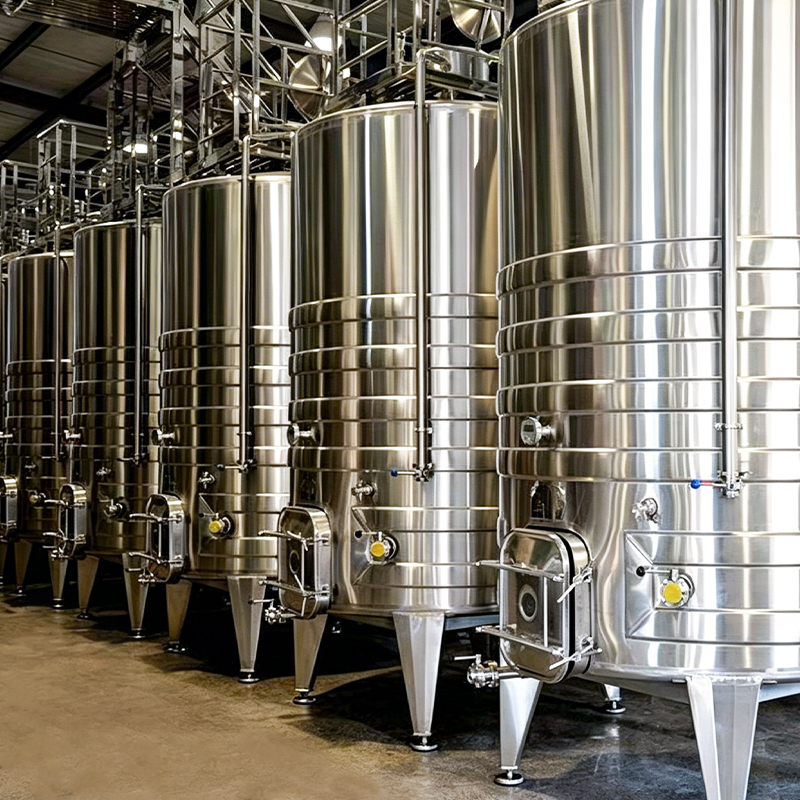 Featured Equipment Red Wine Fermentation Vessel with Automatic Pumping Over This tank automates pumping-over with a PLC-timed rotary spray over the cap, improving phenolic extraction while eliminating manual hose work. A sloped bottom speeds pomace discharge. View Product →
 Materials and Finish: Where Quality Shows Up First
Buy 316L stainless for anything wine touches, and judge the build by its welds and surface numbers — not by the polish video.
SS304 versus SS316L
Both grades sanitize well, but wine is a genuinely corrosive medium: pH 3-4, repeated SO2 additions, and chloride-bearing cleaning agents in many cellars. Type 316L adds 2-3% molybdenum, which sharply improves resistance to pitting at those low pH values. For short-contact storage, 304 is workable. For fermentation and long maceration, 316L is the specification that prevents the pitting scars you would otherwise see in every future vintage.
Surface finish and weld quality
- Product-contact finish: a Ra of 0.8 microns or better is a common sanitary spec, and mirror polishing down toward 0.4 microns makes biofilm removal measurably easier.
- Welds: full-penetration TIG with internal gas purging, then passivation — crevices at internal seams are where cleaning fails first.
- Fittings: sanitary clamp connections on valves and instruments, so every wetted part can be removed, inspected and replaced.
Sizing and Cooling: Do the Math Before the Quote
Two numbers drive tank cost more than any other — working volume and cooling area — and both should come from your harvest reality, not a catalog row.
Capacity math
One tonne of grapes yields roughly 600-700 L of must. Red ferments need 20-25% freeboard for cap expansion and pump-over splash, so a 5,000 L tank comfortably handles a 6-tonne red batch — about 3,900 L of must at roughly 78% fill. Whites can run fuller at 90-95%, which is one reason a 5,000 L white tank ferments closer to 6.5-7 tonnes. For cellars whose volume shifts each vintage, a variable capacity tank with a floating lid and inflatable seal lets one vessel serve loads from half-full to nearly full, safely.
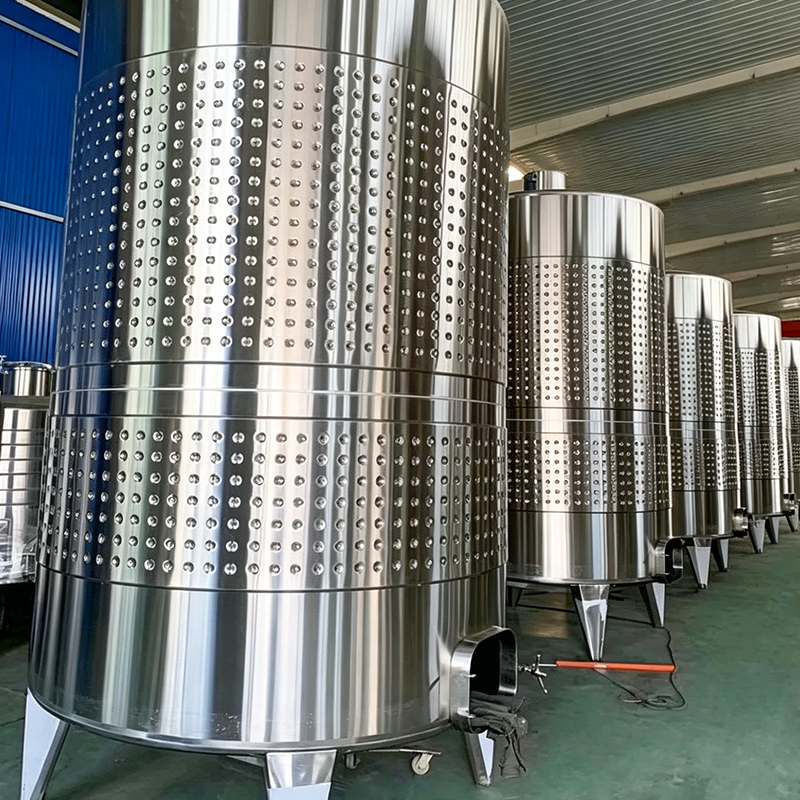 Featured Equipment Variable Capacity Wine Fermentation Tank with Floating Lid With a floating lid and inflatable food-grade gasket, this tank holds volumes from half-full to nearly full without oxidation-prone headspace — a flexible option for cellars whose batch sizes shift each vintage. View Product →
Cooling capacity and controls
Jacket area, not chiller horsepower alone, sets how fast you can pull heat out of a fermenting tank. As a specification test, ask any manufacturer for measured cool-down data — for example, how quickly a full tank drops from 30°C to 15°C at a given glycol supply temperature, typically between -5°C and 0°C. Whites need the deeper reserve; a 13°C white ferment in a tank jacketed only for red work will lag its setpoint on day two. On the control side, insist on a PT100 probe, a controller holding roughly 0.5°C, and HMI data logging — the harvest record ends up being worth as much as the hardware.
Cider, Fruit Wine and Small Batches
Fruit ferments fail in the tank, not in the recipe — pulp packs down, drains clog, and cleaning becomes the bottleneck. Cider and stone-fruit musts behave differently from grape must: more suspended solids, faster foam, and a pomace that needs to exit through a real door, not a 150 mm racking valve.
That is exactly why fruit cider fermenters add a full-size side manway in the lower third of the shell. Pomace is shoveled out in minutes, the door doubles as a cleaning access point, and the cooling jacket still handles temperature without compromise. For estate producers running 500-3,000 L batches, these units pair naturally with a mobile CIP cart instead of a fixed clean-in-place system, keeping the capital budget proportionate to the cellar.
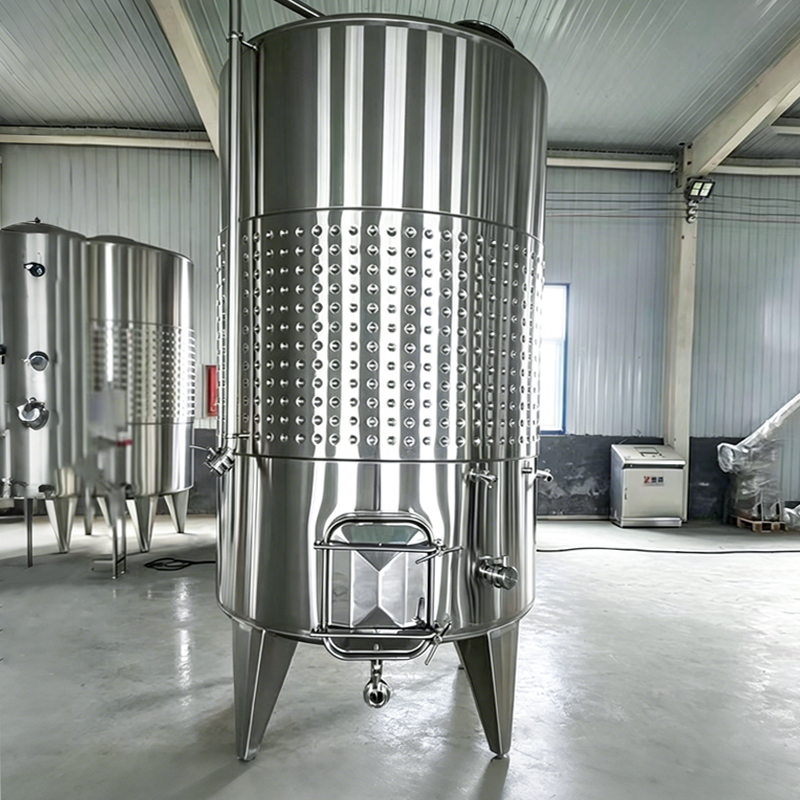 Featured Equipment Fruit Cider Fermenter with Side Manway A large side manway enables fast pomace removal and cleaning access, while the dimple cooling jacket supports slow, cool fermentation — recommended for 500–3,000 L estate producers pairing it with a mobile CIP cart. View Product →
 A Six-Point Checklist Before You Sign
Most tank regrets trace back to six specification gaps. Walk this list with any supplier before you compare prices.
- Ask for measured cooling data: full-tank cool-down time from 30°C to 15°C at your actual glycol temperature, not a jacket-area figure alone.
- Demand weld documentation — full TIG, internal purge, and dye-penetrant or endoscope inspection reports on all product-contact seams.
- Verify CIP coverage: a rotating spray ball rated for your tank diameter, with a demonstrated full-coverage wetting test.
- Match freeboard to process: 20-25% for red cap work, near-full fill with a variable lid for whites.
- Specify the control loop in writing: PT100 sensing, a 0.5°C holding band, high-temperature alarm and exportable data logging.
- Plan the auxiliaries now — pump-over skid, glycol chiller capacity, floor drain slope and pomace route — because retrofitting them later costs multiples.
Work With a Manufacturer That Builds the Whole Line
A fermentation tank is never really a standalone purchase — it inherits its value from the line around it. YME Equipment Co., Ltd builds stainless process vessels across the full beverage chain: wine, cider and yeast fermentation tanks, cooling-jacketed fermenters, CIP cleaning systems and complete turnkey plants for cider, kombucha and wider beverage projects, with design, programming, installation and after-sales support handled by one team.
That breadth matters at specification time. The same engineers who quote your tanks also size the glycol loop, the CIP skid and the pump-over plumbing, so the cooling numbers in your offer reflect a system that has actually been built and commissioned — not a datasheet copy. If you are planning a harvest upgrade or a new cellar, send your batch sizes, grape split and available utilities, and request a detailed quotation built around your real process.
News
-
-
Extracting optimal color and tannins from red wine skins traditionally requires labor-intensive manual "punching down." Our Red Wine Fermentation Vessel automates this process with an integrated pumpi...
READ MORE -
Small to medium-scale detergent producers often face the challenge of inconsistent batch mixing and inefficient material discharge in low-end vessels. Our 500L - 5000L SS304 Single Layer Blending Tank...
READ MORE -
For high-end personal care products, microbial growth in crevices and uneven surfactant distribution are critical quality risks. This Sanitary Single Wall Agitated Tank features a fully radiused inter...
READ MORE -
Building a craft brewery is a complex engineering task requiring the perfect balance between brewing logic and floor space. We provide a complete delivery encompassing the brewhouse, fermentation clus...
READ MORE -
Consistency in yogurt production depends on precise incubation temperatures and a strictly sterile environment for culture inoculation. This end-to-end plant covers the entire process from base mix pr...
READ MORE
YME Equipment
-
Quick Links
Home Products About Solution Service News Contact -
Products Category
Mixing Tanks Storage Tanks Fermentation Tanks Brewing Equipment CIP Cleaning Systems Pasteurizers Beverage & Dairy Turnkey Solutions
-
-
Welcome To Visit Us
No. 15 Yinghua Road, Chengdong Industrial Park, Daxu Town, Xiangshan County, Ningbo City, Zhejiang Province, China -
Call Us
• Mob: +86 0574 6583 9268 -
Contact Us Online
• info@ymeequipment.com
Copyright © YME Equipment Co., Ltd. All Rights Reserved.
OEM/ODM Fluid Process Equipment Manufacturer
Brewery Equipment Supplier
