

 English
 русский
 عربى
Scaling kombucha production requires strict control over oxygen levels and the prevention of cross-contamination. Our commercial line is specifically designed for fermented tea, integrating rapid tea ...
READ MORE
Commercial Fermentation Tanks: Selection Guide for Breweries and Beverage Plants
Content
- 1 Working Volume, Headspace and Batch Planning
- 2 Cooling Jackets and Temperature Control
- 3 Design Pressure, Carbonation and Safety
- 4 Stainless Steel Grade and Surface Finish
- 5 Hygienic Design and CIP Compatibility
- 6 Conical Unitanks for Beer Production
- 7 Wine, Cider and Kombucha Duty
- 8 A Specification Checklist Before You Order
- 9 Cost, Lead Time and Installation Planning
A brewery moving from 15 hL to 40 hL batches recently received two quotes for what looked like identical equipment: six conical fermenters, glycol jackets, CIP spray balls. The cheaper quote came in 22% lower, and the gap sat in three lines of the specification sheet: jacket coverage on the cone, 304 instead of 316L on the wetted shell, and a design pressure of 1 bar rather than 2.5 bar. None of those numbers appear on a capacity label, yet all three decide whether the tank can carbonate, how tightly it holds temperature during a fast ferment, and how long it survives in a permanently wet cellar.
A commercial fermentation tank is defined by four numbers, not by its size: working volume, jacket surface area against coolant temperature, design pressure, and the surface finish of the wetted metal. Nominal capacity only says how much liquid fits inside a shell. If you are still clarifying the fundamentals of the vessel before writing a specification, our note on what a fermentation tank does covers the process basics first.
Working Volume, Headspace and Batch Planning
Fermenters are sold by nominal volume, operated by working volume, and protected by headspace. On a 2,000 L tank the usable batch is typically 1,600 to 1,700 L, because active fermentation generates foam and lift in liquid level that must stay below the spray ball and below the top of the cooling zone. Fill a vessel to 95% and you will lose product through the blow-off arm or relief valve on the first high-krausen day.
A specification that states "working volume 80% of nominal, minimum 20% headspace" is one you can design a cellar around. A specification that simply says "2,000 L" is a marketing number. Ask for working volume in litres, headspace percentage, and the level at which the upper jacket or cooling zone ends.
| Duty | Working volume | Headspace | Practical note |
|---|---|---|---|
| Ale and lager primary fermentation | 80 to 85% of nominal | 15 to 20% | Take the higher figure for top-cropping strains and high-gravity worts |
| Wine and cider | 85 to 90% of nominal | 10 to 15% | Low foam, but must allow for pumping-over and cap management |
| Kombucha and yeast propagation | 70 to 80% of nominal | 20 to 30% | Foaming and oxygen demand both run high early in the cycle |
| Yogurt and dairy fermentation | 85 to 90% of nominal | 10 to 15% | Headspace also houses the agitator shaft and CIP device |
Cooling Jackets and Temperature Control
The cooling decision is made in square metres of jacket area, not in tank count. A fermenter with a single zone covering only the cylindrical shell will hold 12 to 15 °C comfortably and then struggle to pull a 20 °C beer down to 2 °C for cold crash. Cone coverage, dual-zone jackets and glycol supplied at minus 4 to minus 6 °C provide the extra driving force. For lager programmes, roughly 1.2 to 1.5 square metres of jacket per 10 hL of working volume is a realistic starting point, to be checked against your own glycol temperature and target crash time.
Individual temperature control per vessel costs more up front and pays back in consistency. On a shared loop with a single control valve, every fermenter drifts with the demand of its neighbours. With per-vessel control, each tank holds its own setpoint and the glycol plant can be sized on realistic diversity instead of worst-case simultaneity.
 Glycol-Jacketed Pressure-Control Fermenter for Cider and LagerShows how per-vessel glycol control and a spunding valve support pressurized fermentation and cold crashing, while pressure ratings determine carbonation capability.View Product →
Design Pressure, Carbonation and Safety
Design pressure decides what you can do inside the same vessel. A tank rated at 0.5 bar will ferment and can be pushed by gas, but carbonating to 2.5 volumes of CO2 in-vessel requires a higher rating and a certified relief path. Common steps in the market are 1 bar, 1.5 bar, and 2.5 to 3 bar; each step changes wall thickness, cone or dish design, and cost.
- Ask for three separate documented figures: design pressure, test pressure and relief valve setting.
- Confirm whether the vessel is designed as a pressure vessel or as an atmospheric tank with a non-return valve.
- Check that gauge, safety valve and sample valve can all be reached safely from the platform by one operator.
Stainless Steel Grade and Surface Finish
304 handles clean wort, beer and most sugar solutions. 316L is specified where chloride exposure, higher salt content, dairy media, acidic fruit juices or chloride-bearing cleaning agents are present. The molybdenum in 316L resists pitting, and the low-carbon "L" grade protects weld zones in a vessel that is wet for most of its working life.
Surface finish, measured as Ra, matters as much as the alloy. An Ra of 0.8 µm or better on the wetted surface gives a cleanable result for dairy, kombucha and biotech-adjacent duty. Internal welds should be ground flush and pickled or passivated, with no crevices where biofilms survive a wash cycle.
| Element | Standard choice | Upgrade choice | Risk if ignored |
|---|---|---|---|
| Wetted shell | 304 | 316L | Pitting at welds under chloride-bearing cleaning or juice duty |
| Internal finish | Ra 0.8 µm or better | Ra 0.4 µm mirror polish | Biofilm retention and failed swab tests |
| Weld treatment | Ground and passivated | Fully ground with documented passivation | Crevice corrosion and leaking seams |
| Insulation | 50 mm PU with cladding | 80 to 100 mm, sealed cladding | Condensation, higher glycol load, wasted energy |
Hygienic Design and CIP Compatibility
CIP performance is designed into the geometry. A spray device sized for the tank diameter and positioned so the jet reaches the top of the cone and the underside of the manway cleans the vessel in 20 to 30 minutes at the correct flow, temperature and concentration. An undersized device leaves shadow areas, and shadow areas are where the next batch of lactic acid bacteria comes from.
Points worth writing into the purchase order: 1.5 to 2.5 bar cleaning pressure at the device, tri-clamp or DIN 11851 connections, a sloped floor draining to a single low point, a manway large enough for a person, and sample valves above the liquid line rather than in the yeast zone.
Conical Unitanks for Beer Production
A unitank ferments and conditions in one vessel, which is why most craft breweries between 5 hL and 100 hL standardise on them. The essentials are a 60-degree cone for yeast collection and even drainage, a racking arm set above the yeast bed, a carbonation stone, a dry-hop port and a sample valve. Cone geometry also determines how much clear beer you recover before the yeast cone is disturbed.
 SS316L Sanitary Unitank for Large-Scale Craft BreweriesElectro-polished unitank with rotary CIP and top dry-hop port supports combined fermentation and conditioning, helping match vessel count to demanding brewing schedules.View Product →
Tank count follows from the brewing schedule, not from floor space. Brewing five times a week with a nine-day fermentation needs at least ten vessels, plus one more for conditioning or cleaning rotation. Underestimating that number is the most common error in a new cellar: the tanks arrive, the schedule is written, and both the cooling load and the CIP rotation assume a tank count that does not exist.
Wine, Cider and Kombucha Duty
Vessels for wine, cider and kombucha are built around different priorities than beer tanks: wider manways for fruit and pomace handling, gentler agitation for maceration, and in some cases variable-capacity designs that let one tank run at 60% or 100% fill without losing cooling performance. Oxygen strategy inverts as well, because kombucha and cider benefit from controlled oxygen early while wine needs protection from it after primary fermentation.
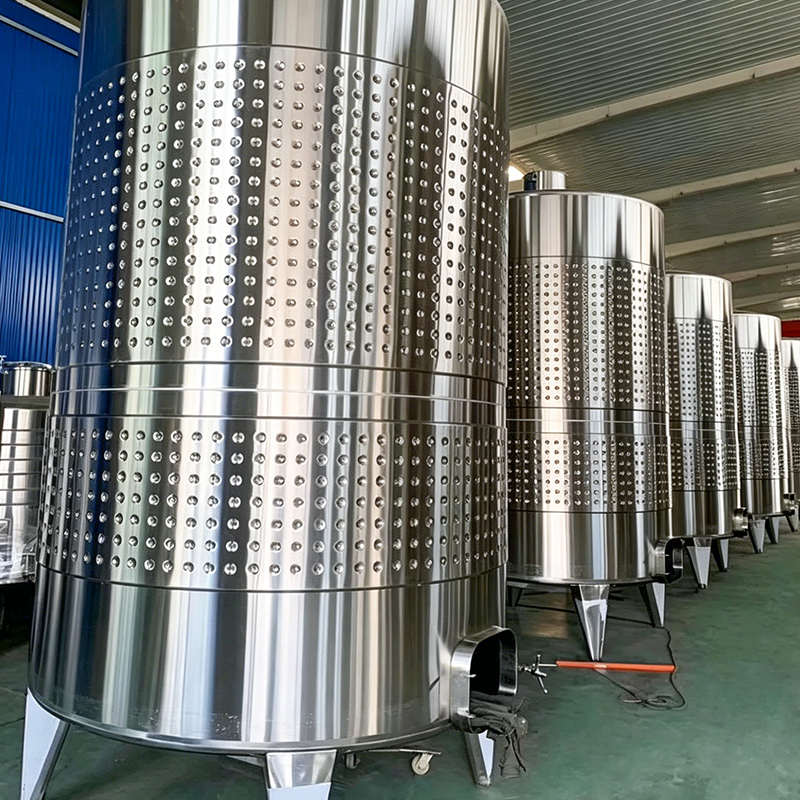 Variable Capacity Wine Fermentation Tank with Floating LidFloating-lid design eliminates headspace to protect delicate aromas while accommodating varying fill levels, and shares cellar fittings and cleaning procedures across the tank range.View Product →
Yeast propagation adds its own requirement: a sterile, aerated, well-mixed vessel with tight temperature control and ports sized for laboratory-style hygiene. Because this family shares the same shell, jacket and fitting platform as the wider wine and cider fermentation tank range, spare parts, gaskets and CIP procedures stay consistent across the whole cellar.
A Specification Checklist Before You Order
- Working volume in litres, headspace percentage, and the level where the top cooling zone ends.
- Jacket area per 10 hL, number of zones, glycol supply temperature and required crash time.
- Design pressure, test pressure and relief valve setting, each documented separately.
- Alloy grade for shell and jacket, plus an Ra figure and weld treatment standard.
- Connection standard, spray device flow rate, manway size and valve positions.
- Control scope: per-vessel temperature control, sensor type, data logging and alarm points.
Cost, Lead Time and Installation Planning
Price gaps between quotes usually trace back to four hidden variables: jacket area, alloy grade, insulation thickness and automation level. A cheaper vessel is rarely cheaper for the same specification, so ask each supplier to quote against the same line-item schedule before comparing totals. Custom vessels commonly run 10 to 16 weeks from drawing approval, plus shipping, rigging and commissioning time on site.
Installation planning is where projects slip. Cellar height decides whether a tank can stand upright under the pipework, floor loading and anchor points must be confirmed before delivery, and glycol mains need to be sized for the total connected load rather than the average. Confirming those three items early keeps the commissioning week short and predictable.
The practical rule: buy fermentation tanks against your process data, not against a capacity label. Volume, jacket area, pressure rating and finish are the four numbers that determine whether the cellar performs as planned in year one, and whether it still performs in year ten.
News
-
-
Scaling production to industrial volumes requires vessels that can withstand massive hydrostatic pressure without compromising sanitary standards. Our Industrial Beer Fermentation Vessels are engineer...
READ MORE -
In biotechnology and vaccine production, the slightest microbial contamination can lead to catastrophic batch failure. Our GMP Standard Buffer Tank solves this through a dead-leg-free, self-draining d...
READ MORE -
In micro-breweries where space is at a premium, a fixed CIP station is often impractical. This Portable Manual CIP System is designed with a narrow footprint to fit through standard doors and navigate...
READ MORE -
For natural juices without preservatives, Hot-Filling is the most cost-effective method to ensure long-term shelf stability. This turnkey solution synchronizes pasteurization and filling, where the pr...
READ MORE -
Every day of delayed production is lost revenue during a new business launch. Our "Plug-and-Play" Stainless Steel Brewing Skid is fully assembled, passivated, and factory-tested before shipping. Once ...
READ MORE
YME Equipment
-
Quick Links
Home Products About Solution Service News Contact -
Products Category
Mixing Tanks Storage Tanks Fermentation Tanks Brewing Equipment CIP Cleaning Systems Pasteurizers Beverage & Dairy Turnkey Solutions
-
-
Welcome To Visit Us
No. 15 Yinghua Road, Chengdong Industrial Park, Daxu Town, Xiangshan County, Ningbo City, Zhejiang Province, China -
Call Us
• Mob: +86 0574 6583 9268 -
Contact Us Online
• info@ymeequipment.com
Copyright © YME Equipment Co., Ltd. All Rights Reserved.
OEM/ODM Fluid Process Equipment Manufacturer
Brewery Equipment Supplier
