What Are Vertical Liquid Storage Tanks?
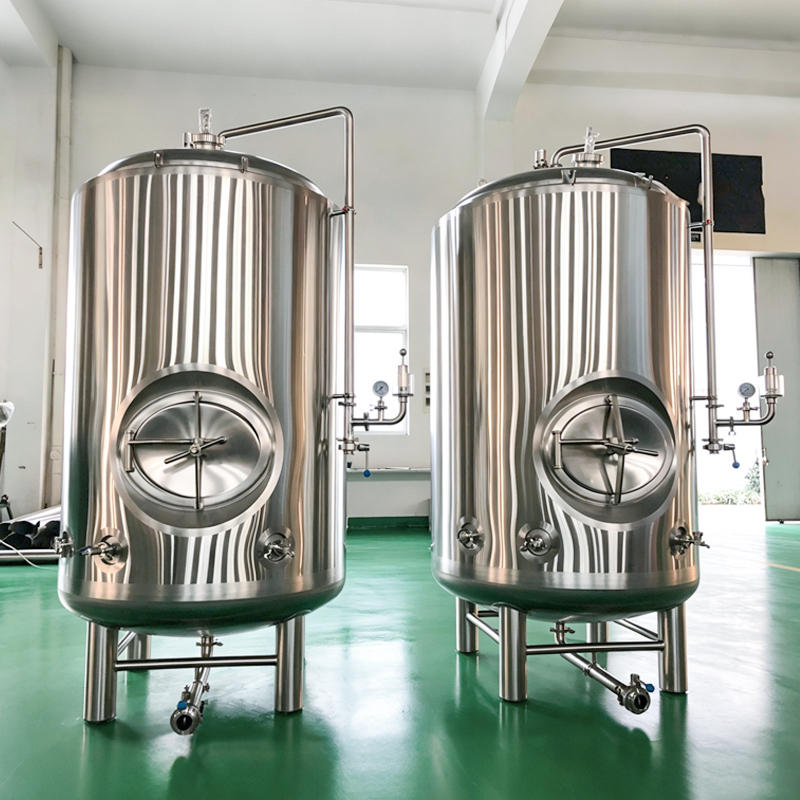
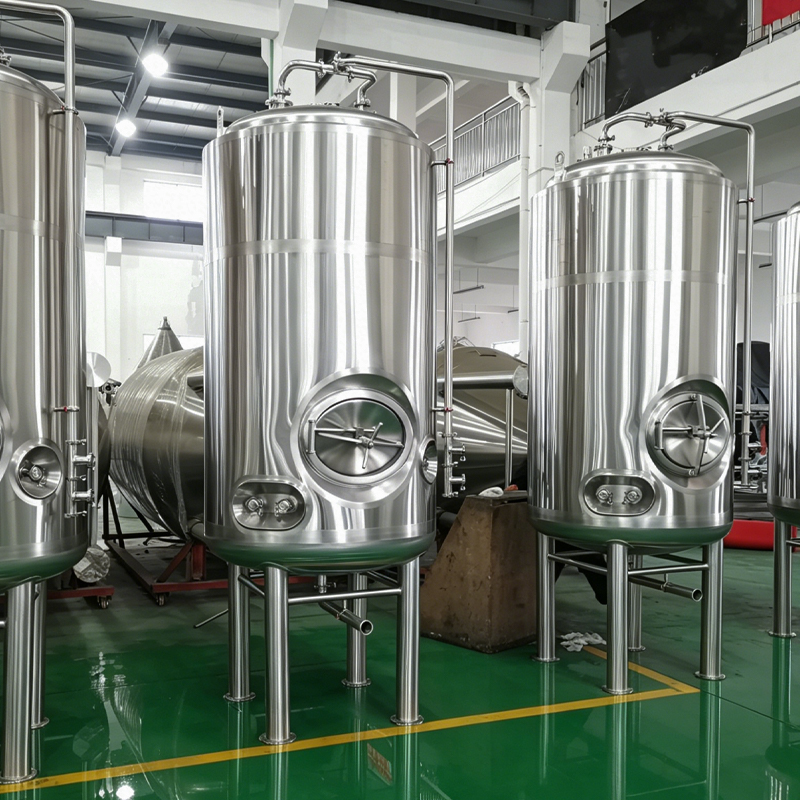
Vertical Liquid Storage Tanks are upright cylindrical vessels supported on legs, a skirt, or a flat base, designed to hold liquid products such as water, beer, wine, juice, and dairy while occupying a comparatively small floor footprint. Their standing orientation makes them the default choice for breweries, beverage plants, and dairy facilities where floor space is limited but ceiling height allows for a taller vessel.
Most vertical tanks feature a flat, sloped, or conical bottom that channels product toward a single center-bottom outlet, which is a key structural advantage over other tank orientations when it comes to complete drainage and sediment control.
Key Advantages of Vertical Liquid Storage Tanks
Vertical tanks are widely adopted across the beverage and dairy industries because of several practical benefits.
- Compact floor footprint — a vertical layout stores significantly more volume per square meter of floor space than a horizontal equivalent
- Efficient gravity-fed drainage through a conical or sloped bottom, leaving minimal residual product
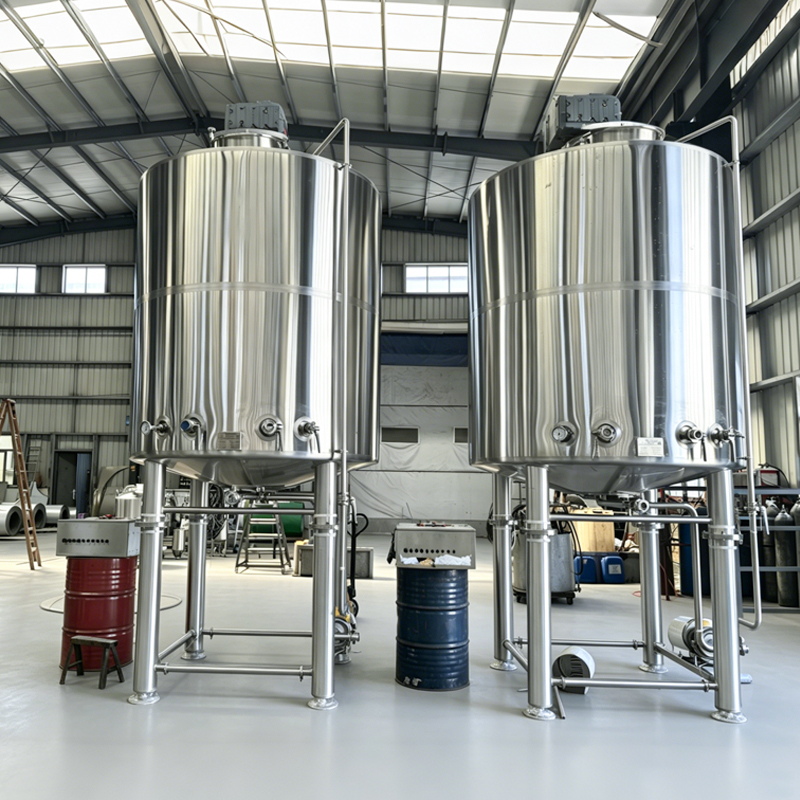
- Straightforward integration of top-mounted or side-entry agitators for blending and particulate suspension
- Simplified CIP spray-ball coverage, since the cylindrical wall and sloped bottom create predictable spray patterns
- Easier stacking of multiple process functions (storage, blending, brief holding) within one tank when equipped with the right internals
Product enters a vertical tank through a top or side inlet and settles under gravity toward the base, where a center-bottom outlet valve controls discharge. Level sensors or sight glasses allow operators to monitor fill volume, while a vent or pressure relief valve regulates internal pressure as the tank fills, empties, or experiences temperature changes.
For temperature-sensitive products, an insulated or glycol-jacketed shell maintains the liquid within its required range, and the jacket can be zoned into separate sections to allow different temperature control at different heights of the tank. Where blending or homogenization is required, a motor-driven agitator mounted through the top head keeps particulates or ingredients evenly distributed rather than settling at the bottom.
Bottom Design and Drainage Efficiency
The angle of the tank's bottom head has a direct impact on drainage performance. A cone bottom with a steep slope (commonly 60–90 degrees) drains more completely than a flat or shallow-sloped base, which matters most for products with particulates, yeast, or sediment that need to be fully removed between batches.
Choosing Tank Capacity and Configuration
Vertical tank sizing depends on daily production volume, batch scheduling, and how much buffer capacity a plant needs between processing steps. The table below outlines general capacity tiers commonly seen across the beverage and dairy sector.
General capacity tiers for vertical liquid storage tank installations
| Facility Scale |
Typical Tank Volume |
Common Configuration |
| Small craft / pilot |
500L – 3,000L |
Single-wall or basic jacketed |
| Mid-size production |
5,000L – 20,000L |
Glycol-jacketed with agitator option |
| Large commercial plants |
30,000L – 100,000L+ |
Multi-zone jacketing, automated CIP |
Industry Applications and Manufacturing Expertise
Vertical liquid storage tanks are the standard choice for brewery bright beer storage, wine and juice holding, dairy processing intermediate storage, and general water storage where floor space is limited but vertical clearance is available. They are also frequently used in blending applications where an agitator needs to combine multiple ingredients before the product moves downstream.
As a China-based OEM/ODM manufacturer of fluid process and brewery equipment with over 20 years of industry experience, YME Equipment Co., Ltd designs and manufactures vertical liquid storage tanks as part of complete brewhouse, fermentation, and CIP system solutions. YME's designers, engineers, and production staff continuously undergo advanced training to stay current with industry trends, allowing the company to adapt tank designs to projects of varying size and complexity. YME's stainless steel equipment has been exported to customers across Europe, North America, Australia, and Asia, supported by long-term partnerships built on consistent product quality and precise, tailored engineering.
Frequently Asked Questions
Q1: What bottom shape is best for a vertical liquid storage tank?
A cone bottom is generally preferred for products with particulates or sediment, while a flat or slightly sloped bottom is often sufficient for clear liquids like water or filtered beverages.
Q2: Do vertical tanks require support legs or a skirt base?
Smaller tanks are commonly mounted on support legs, while larger vertical tanks typically use a welded skirt base for added stability and even weight distribution on the foundation.
Q3: Can a vertical liquid storage tank be used for both storage and blending?
Yes, when fitted with a top-mounted agitator, a vertical tank can perform both functions, holding product while continuously or periodically blending ingredients to maintain uniformity.
Q4: How is temperature maintained in a vertical storage tank?
Temperature is typically maintained through an insulated glycol or hot-water jacket wrapped around the tank shell, which can be divided into multiple zones for more precise control across the tank's height.



 English
 русский
 عربى
عربى