

 English
 русский
 عربى
Temperature-sensitive chemicals can degrade or react prematurely if not held under strict thermal conditions. Our Thermal Control Jacketed Storage Vessel is the ultimate solution for maintaining preci...
READ MORE
Jacketed Mixing Vessel: How to Choose for Heating, Cooling, and Blending
Content
- 1 Jacketed Mixing Vessel: The Right Start for Controlled Heating and Blending
- 2 Jacket Type Is the First Decision
- 3 Agitator Selection and Temperature Control
- 4 Seven-Point Checklist Before You Buy
- 5 Material Grade, Surface Finish, and Construction Details
- 6 Where a Jacketed Mixing Vessel Earns Its Keep
- 7 Put the Process First, Then the Vessel
Jacketed Mixing Vessel: The Right Start for Controlled Heating and Blending
A jacketed mixing vessel has one job that sounds simple: mix the product while holding its temperature inside a set range. In practice, that means balancing heat transfer surface, agitator shear, jacket pressure, cleaning access, and material finish. The conclusion is straightforward: get those variables right, and the vessel becomes a reliable batch platform; get them wrong, and you spend years fighting hotspots, slow batches, or product separation.
Most processors use this type of vessel for heating, cooling, blending, dissolving, or holding a liquid product before the next process step. The principle becomes easier to follow when you understand what happens inside a mixing tank: an agitator transfers mechanical energy into the product, while the jacket transfers heat into or out of the product through the vessel wall. Both actions happen at the same time, which is why the design needs to be treated as a system rather than a simple tank.
Jacket Type Is the First Decision
The jacket controls the heating or cooling capacity of the vessel. Before you choose a jacketed mixing vessel, confirm the utility fluid available in your plant: steam, hot water, thermal oil, glycol, or chilled water. Each media changes the required jacket pressure, flow rate, and material thickness.
| Jacket Type | Heat Transfer Area | Typical Use | Pressure Range |
|---|---|---|---|
| Plain plate | Low to moderate | Mild heating or cooling on low-viscosity products | Atmospheric or low pressure |
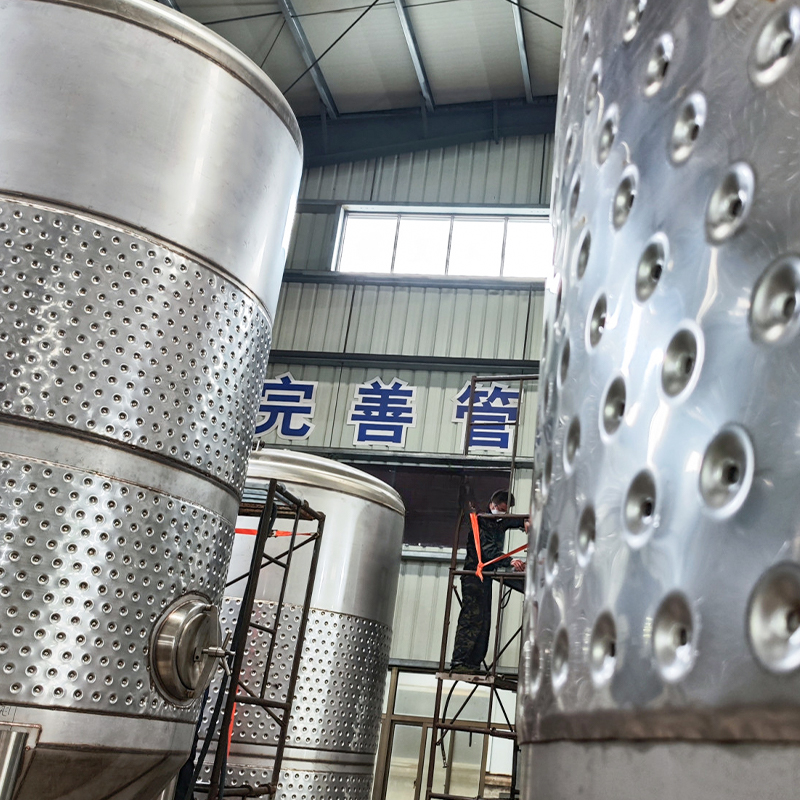
| Dimple jacket | High | Food, beverage, and chemical batches needing faster heat transfer | Moderate pressure |
| Half-pipe coil | High, with zone control | High-temperature heating, glycol cooling, or multi-zone processes | High pressure |
For most 500 L to 5,000 L mixing vessels, a dimple jacket gives a strong balance of heat transfer area, weight, and cost. It is a common choice when the process needs faster heating or cooling without switching to a complex high-pressure coil. If your batch size and utility supply fit that middle range, a standard dimple-jacketed design is often the most practical starting point.
 1000L Dimple Jacketed Thermal Mixing Vessel for Sensitive FluidsThis vessel's dimple jacket increases heat transfer area and promotes uniform temperature, addressing hot spots that degrade resins or syrups. It suits batches of 500–5,000 L where faster heating or cooling is needed without complex coils.View Product →
Agitator Selection and Temperature Control
The agitator must match the product's viscosity, shear sensitivity, and mixing objective. Temperature control is not just about the jacket; it depends on how quickly the product moves across the heated surface. A slow sweep near the wall prevents burning, while a faster impeller improves heat transfer but may damage fragile fluids.
- Anchor agitator: a large-diameter, low-speed sweep that works well with high-viscosity products and helps prevent scorching on the jacket wall.
- Turbine or pitched-blade agitator: higher shear for dissolving powders, blending miscible liquids, or improving heat transfer in lower-viscosity batches.
- High-shear rotor-stator head: needed for emulsions, dispersions, or particle size reduction inside the same vessel.
- Variable frequency drive: lets you adjust impeller speed by batch stage, which protects shear-sensitive products and saves energy during holding periods.
Accurate temperature control usually comes from a temperature sensor, a control valve, and a jacket design that delivers a consistent flow to the heat transfer surface. For processes that require tight temperature control during heating, mixing, and holding, a high-precision jacketed agitator tank with temperature control is a direct solution.
 High-Precision Jacketed Agitator Tank with PID Thermal ControlWith PID control and dual-speed agitation, this tank holds temperature within ±0.5°C, preventing batch failure in pharmaceutical and advanced synthesis. Ideal for tight thermal management during heating, mixing, and holding stages.View Product →
Seven-Point Checklist Before You Buy
A jacketed mixing vessel is a capital purchase. The fastest way to avoid rework is to verify the specification before you order. Work through these points with your process engineer and equipment supplier.
- Confirm the jacket type and heating or cooling media. Steam, hot water, thermal oil, glycol, and chilled water each change the design.
- Check wetted materials. For food, dairy, or pharmaceutical use, choose 304 or 316L stainless steel with a documented surface finish.
- Define working pressure and temperature. The vessel and the jacket must match the utility supply in your plant.
- Verify agitator torque and speed range. The motor should handle the worst-case viscosity, not just the final batch.
- Look for cleanability. A manway, sloped bottom, and CIP spray ball reduce manual cleaning time.
- Ask about instrumentation and control. A temperature sensor, pressure gauge, and VFD are common minimums.
- Sort out lead time and documentation. Material certificates, weld traceability, and hydrostatic test reports matter for audits.
A written specification protects both sides. If the product changes later, the documentation makes it easier to evaluate whether the existing vessel can handle the new process.
Material Grade, Surface Finish, and Construction Details
Stainless steel grade determines corrosion resistance. 304 is enough for many food and beverage products, while 316L is the standard for acidic, chloride-containing, or pharmaceutical products. The L grade limits carbon precipitation during welding, which keeps the material stable and easier to clean.
Surface finish affects both cleaning and product release. For sanitary processes, a mirror polish with Ra 0.4 to 0.8 µm is common. Internal welds should be continuous, ground smooth, and free of crevices. A rough surface gives bacteria or product residue a place to hide, so do not treat the finish as a cosmetic detail.
Insulation and cladding are also part of the design. If a vessel must hold temperature between heating and cooling steps, an insulated jacket reduces energy loss and improves batch consistency. This is especially relevant for syrup, resin, and other temperature-sensitive products that spend time in the tank before the next process step.
 Insulated Jacketed Tank with Scraper Agitator for Syrup & ResinA dual-layer thermal barrier reduces energy loss while the Teflon scraper prevents scorching on heated walls. Designed for viscous materials like glucose syrup and resin, it maintains batch consistency between heating and cooling steps.View Product →
Where a Jacketed Mixing Vessel Earns Its Keep
The same vessel family is used across different industries. The process requirements change the specification, not the overall concept. The table below shows the typical starting points for common applications.
| Application | Typical Product | Key Requirement | Common Jacket Type |
|---|---|---|---|
| Food and beverage | Syrups, sauces, dairy blends | Sanitary finish, CIP compatibility | Dimple or plain |
| Brewing and fermentation | Wort, yeast slurry, beer | Cooling rate, gentle agitation | Half-pipe or dimple with glycol |
| Chemical and cosmetics | Waxes, oils, creams, emulsions | Corrosion resistance, high shear | Half-pipe or high-shear unit |
| Pharmaceutical and biotech | Buffers, solutions, intermediates | Polished 316L, GMP documentation | Dimple or half-pipe |
Use the table as a scoping guide, not a final specification. Your real duty cycle, cleaning procedure, and utility limits will determine the exact design.
Put the Process First, Then the Vessel
Choose the jacket type once you know your heating and cooling media. Choose the agitator once you know your viscosity and shear sensitivity. Then confirm material finish, cleanability, instrumentation, and documentation. A jacketed mixing vessel is only effective if it works with the rest of your line.
At YME, we build jacketed mixing vessels for food, beverage, chemical, cosmetic, and pharmaceutical process lines. Tell our process engineering team what you need to produce, how hot or cold the process must run, and how you plan to clean the tank. We will turn that into a vessel specification you can audit, install, and operate with confidence.
News
-
-
Maintaining biological stability and achieving perfect carbonation in a single vessel is critical for modern craft brewing. This Unitank features independent dual-zone cooling jackets (cone and sidewa...
READ MORE -
Cleaning and discharging high-viscosity pastes from large vacuum tanks can be labor-intensive and hazardous. Our Automatic Lifting Vacuum Mixing Machine features a hydraulic lifting head that raises t...
READ MORE -
In chemical processing, the slow dissolution of powders into liquids can significantly bottleneck production timelines. Our High-Speed Open-top Chemical Mixing Vessel is designed to eliminate this bot...
READ MORE -
The primary pain point in industrial batching is the residue left in flat-bottom tanks, which leads to cross-contamination and excessive water waste during cleaning. Our Conical Bottom Vertical Tank i...
READ MORE -
Thermal stratification and localized overheating are common pain points when processing temperature-sensitive resins or syrups. Our 1000L Dimple Jacketed Thermal Mixing Vessel utilizes an advanced dim...
READ MORE
YME Equipment
-
Quick Links
Home Products About Solution Service News Contact -
Products Category
Mixing Tanks Storage Tanks Fermentation Tanks Brewing Equipment CIP Cleaning Systems Pasteurizers Beverage & Dairy Turnkey Solutions
-
-
Welcome To Visit Us
No. 15 Yinghua Road, Chengdong Industrial Park, Daxu Town, Xiangshan County, Ningbo City, Zhejiang Province, China -
Call Us
• Mob: +86 0574 6583 9268 -
Contact Us Online
• info@ymeequipment.com
Copyright © YME Equipment Co., Ltd. All Rights Reserved.
OEM/ODM Fluid Process Equipment Manufacturer
Brewery Equipment Supplier
