

 English
 русский
 عربى
In biotechnology and vaccine production, the slightest microbial contamination can lead to catastrophic batch failure. Our GMP Standard Buffer Tank solves this through a dead-leg-free, self-draining d...
READ MORE
Stainless Steel Wine Tank Guide: Types, Materials, and Design Considerations
Content
- 1 Stainless Steel Wine Tanks Are the Core of Modern Winery Process Design
- 2 Why Stainless Steel Is the Default Wine Tank Material
- 3 Main Types of Stainless Steel Wine Tanks in a Working Cellar
- 4 Steel Grade and Surface Finish: Material Details That Change CIP Efficiency
- 5 Practical Specification Checklist for Stainless Steel Wine Tanks
- 6 Choose the Supplier, Not Just the Tank
Stainless Steel Wine Tanks Are the Core of Modern Winery Process Design
A winery planning to raise fermentation capacity from 20,000 L to 60,000 L will normally evaluate stainless steel wine tanks before any other equipment category. The tank fleet generally represents one of the largest capital items in a winery project, and it affects fermentation control, cellar labor, cleaning time, and final wine quality for ten years or more. The practical conclusion is simple: do not choose a stainless steel wine tank by price per liter alone. The correct specification depends on tank type, steel grade, internal surface roughness, cooling jacket design, and automation interfaces.
This guide explains what those decisions mean in real winery operation. It covers the main tank categories used for red wine, white wine, aging, and fruit-based alcoholic beverages; the differences between 304 and 316L stainless steel; and the process parameters that separate a good tank from a costly long-term mistake.
Why Stainless Steel Is the Default Wine Tank Material
Stainless steel became the winery standard because it offers the most balanced combination of chemical inertness, cleanability, and temperature control of any commercial tank material. The main reasons are measurable and directly related to wine quality:
- The inner surface is an inert chromium oxide layer. On AISI 304 and 316L, this protective film prevents metal ions from entering wine and does not react with phenolic compounds or organic acids in the pH range of wine. Wine does not pick up a woody or mineral flavor from the steel itself.
- The tank can be cleaned with hot caustic and acid sequences. Typical CIP programs use 70-80 degrees C caustic solution followed by an acid rinse. The smooth stainless steel surface allows wine tartrate deposits and biofilms to be removed without damaging the tank.
- Cooling can be controlled precisely. A glycol jacket on a stainless steel tank provides a reliable heat-transfer surface, allowing white wine fermentation to stay at 12-15 degrees C and red wine fermentation to run at 25-28 degrees C without hot spots.
- The material is mechanically strong and durable. A well-designed stainless steel tank can be built for slight internal pressure, fitted with sight glasses and valves, and expected to serve a winery for 20 years or more.
A key nuance is that stainless steel is only inert if the specified grade, surface finish, and welding quality are correct. That is why material selection deserves more attention than tank size in the early specification stage.
Main Types of Stainless Steel Wine Tanks in a Working Cellar
Most wineries do not need a different tank for every fermentation style. Four basic stainless steel tank families cover the standard cellar program: red wine fermenters, white wine and variable-capacity tanks, aging and storage tanks, and fruit cider fermenters. The right family depends on how you manage cap, temperature, oxygen exposure, and solid removal.
Red Wine Fermenters
Red wine fermentation is mostly about cap management. Pumping-over is the most common method: juice from the tank bottom is pumped over the grape cap to control extraction of tannin and color. An automatic pumping-over tank is often a vertical cylindrical vessel with a cone bottom, upper and lower glycol cooling zones, a sampling valve, and a dedicated return port for the juice spray. The circulation flow is normally sized for a full tank turnover in 15-20 minutes, which gives the cellar staff reliable extraction control without manual punch-down.
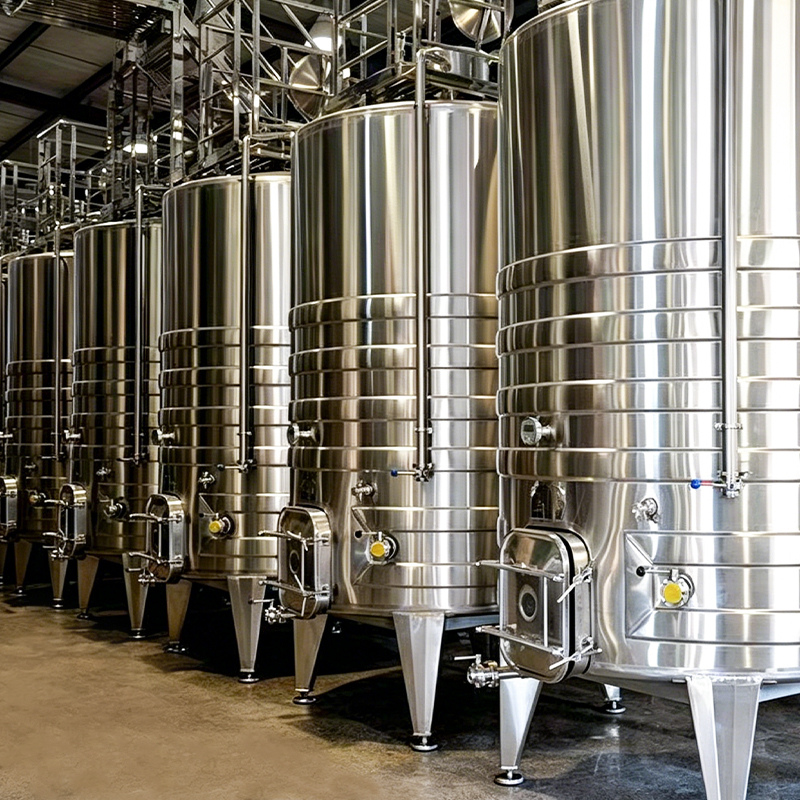 Red Wine Fermentation Vessel with Automatic Pumping OverExtracting optimal color and tannins from red wine skins traditionally requires labor-intensive manual "punching down." Our Red Wine Fermentation Vessel automates this...View Product →
White Wine and Variable-Capacity Tanks
White wine tanks are selected to limit oxygen and preserve reductive aromas. Fermentation at 12-15 degrees C is usually done under a low nitrogen or carbon dioxide cover, so the tank headspace becomes as important as the tank body. Variable-capacity stainless steel tanks reduce the gas space above the wine by using a floating lid or an adjustable internal cover. They work well for aromatic whites that need sulphur dioxide management and reductive storage before bottling. The tank must include an inert gas inlet, a pressure/vacuum relief device, and a tight manway seal to maintain the desired atmosphere.
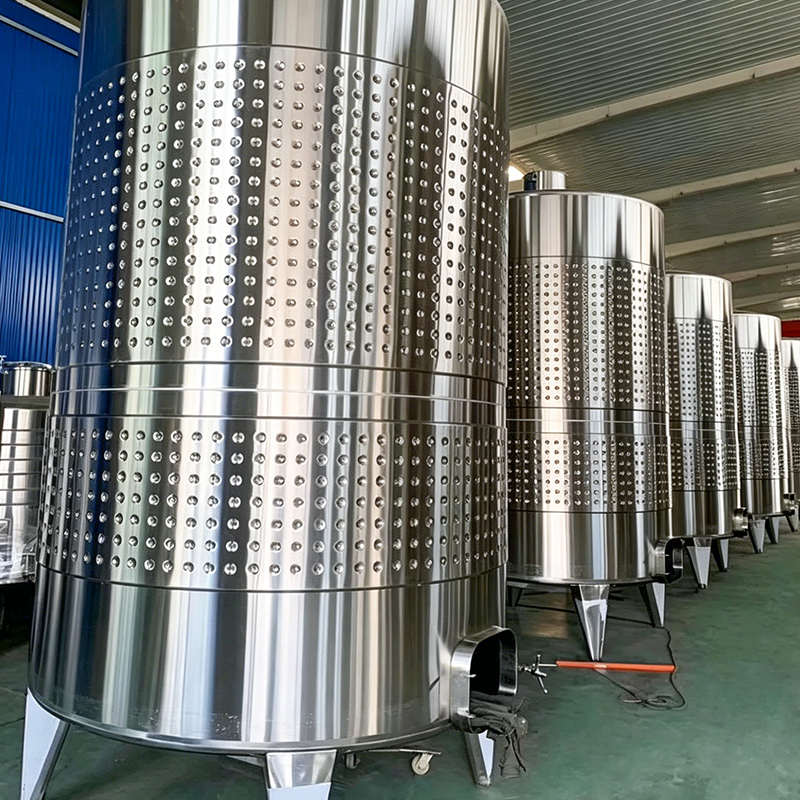 Variable Capacity Wine Fermentation TankSmall-batch wineries often struggle with oxidation when harvest yields or fermentation volumes don't perfectly match tank capacity. Our Variable Capacity Wine Fermenta...View Product →
Aging and Storage Tanks
After barrel aging, wine usually moves into stainless steel for blending, stabilization, and bulk storage. Large vertical tanks with conical or sloped bottoms are common because they allow complete drainage and easy removal of lees. Horizontal insulated tanks are preferred in cellars with limited ceiling height. A useful distinction from fermentation tanks is that storage tanks are designed to be full, with minimal headspace, and to accept frequent cleaning. For a broader comparison of tank configurations, see this overview of different types of storage tanks.
Fruit Cider Fermenters
Cider and fruit wine processing bring more suspended solids, fruit pulp, and gas release than grape must fermentation. A fruit cider fermenter therefore needs a side manway that opens low enough for sediment removal and internal inspection. Side sight glasses, a wide fill port, and a cone angle that allows pomace to slide out are more relevant than in standard grape tanks. The steel grade remains the same, but the openings and cleaning features change.
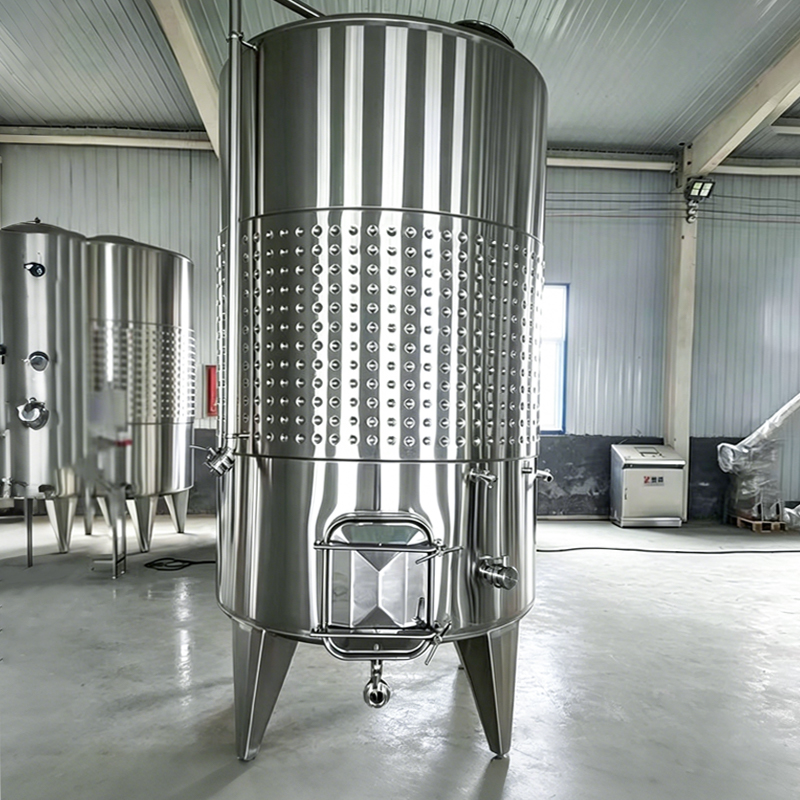 Fruit Cider Fermenter with Side ManwayManaging fruit pulp and solids during cider fermentation requires equipment that facilitates easy manual access and efficient mechanical cleaning. This Fruit Cider Fer...View Product →
Steel Grade and Surface Finish: Material Details That Change CIP Efficiency
The internal surface finish of a stainless steel wine tank has a direct, measurable effect on cleaning time and tartrate buildup. The steel grade controls long-term resistance to acid, chloride, and cleaning chemicals.
AISI 304 is the default stainless steel for most wine tanks. AISI 316L adds 2-3% molybdenum, which improves resistance to pitting and corrosion in chloride environments and in contact with more aggressive acid cleaners. For normal red and white wine production, 304 is the standard choice. For high-acid fruit wines, heavily chlorinated rinse water, sterile filtration lines, or CIP circuits with strong acid steps, 316L is the more reliable option.
| Comparison item | AISI 304 | AISI 316L |
|---|---|---|
| Molybdenum content | None | 2%-3% |
| Typical use in winery | Fermentation, storage, blending | High-acid fruit wine, aseptic buffers, CIP lines |
| Corrosion behavior with acidic cleaners | Suitable for standard wine cellar rinses | Higher resistance to strong acid and chloride cycles |
| Practical selection advice | Standard choice for most red and white wine tanks | Preferred for high-acid fruit wines and long-term juice contact |
| Surface finish range | Ra 0.4-0.8 micrometers | Ra 0.4-0.8 micrometers |
Surface finish is expressed as average roughness Ra. A fermentation tank with Ra 0.8 micrometers is acceptable in most cellars, while Ra 0.4 micrometers and mirror-polished surfaces reduce deposit adhesion and make CIP shorter. Mirror polish, often called 2M finish, is recommended for aseptic storage tanks and tanks that remain in contact with wine for several months.
Practical Specification Checklist for Stainless Steel Wine Tanks
Once the tank family and material are defined, the remaining decisions are geometry, cooling, openings, and instrumentation. Start from the process, not from a standard drawing.
- Capacity and fill ratio. Fermentation tanks should leave 15-20% empty headspace for foam and gas release. Storage tanks are sized close to full volume with only 2-3% expansion space.
- Cooling surface. A rule of thumb is 0.3-0.6 square meters of glycol jacket area per cubic meter of tank volume. Red wine fermenters with high fermentation rates use the higher end of that range; white wine tanks often use a single jacket over the active fermentation zone.
- Tank openings. Place the manway, sight glass, temperature probe, return port, and inert gas inlet before fabrication. A poorly placed manway forces operators to lean over the cap or to rinse longer after CIP.
- Cleaning and drainage. The bottom must slope completely to the outlet. A 5-8% slope on a cone or a dished bottom prevents pooling of wine and cleaning solution. Add a CIP spray ball or rotary head plus a bottom valve with low dead volume.
- Controls and sensors. A stem temperature probe in the middle third of the tank gives the most representative fermentation temperature. If the winery uses PLC control, specify the signal type, cable entry, and valve actuation in advance.
A good stainless steel wine tank is the one that fits your cellar flow, not the one with the largest standard catalog volume.
Choose the Supplier, Not Just the Tank
Correctly configured, a stainless steel wine tank gives twenty years of stable service; incorrectly configured, it creates slow cleaning, uneven fermentation temperature, and frequent repair access problems. The cost of those problems will exceed the initial price difference between two quotations.
When preparing a requirement, include fermentation temperature range, tank capacity per batch, juice circulation method, CIP chemical sequence, available building height, and automation level. YME Equipment Co., Ltd. designs and fabricates stainless steel wine fermenters with 304/316L material, mirror or fine mechanical polish, glycol cooling jackets, and automated pump-over options. YME also integrates fermentation tanks with CIP systems and process lines for wineries, cideries, and fruit beverage plants. For a tailored specification and project quotation, contact YME directly.
In short, a stainless steel wine tank is the containerized expression of your winemaking process. Specifying it around the process, rather than around a catalog price, is the most reliable way to avoid costly regrets.
News
-
-
Post-filling condensation is a major threat to packaging quality; cold-filled cans in humid factories "sweat," causing labels to peel and cardboard boxes to weaken. Conversely, hot-filled juices can r...
READ MORE -
Processing high-viscosity materials like syrup often leads to significant energy loss and slow heat-up times in uninsulated tanks. Our Insulated Jacketed Tank solves this by integrating a dual-layer t...
READ MORE -
Sticky sugars and pulp in juice lines require precise thermal management to prevent caramelization during cleaning. This specialized Semi-Automatic CIP system is optimized for high-viscosity residues....
READ MORE -
Every day of delayed production is lost revenue during a new business launch. Our "Plug-and-Play" Stainless Steel Brewing Skid is fully assembled, passivated, and factory-tested before shipping. Once ...
READ MORE -
Precision in finished beer volume and CO2 levels is non-negotiable for commercial packaging. This Brite Beer Tank is equipped with a high-accuracy sanitary level gauge and a precision carbonation ston...
READ MORE
YME Equipment
-
Quick Links
Home Products About Solution Service News Contact -
Products Category
Mixing Tanks Storage Tanks Fermentation Tanks Brewing Equipment CIP Cleaning Systems Pasteurizers Beverage & Dairy Turnkey Solutions
-
-
Welcome To Visit Us
No. 15 Yinghua Road, Chengdong Industrial Park, Daxu Town, Xiangshan County, Ningbo City, Zhejiang Province, China -
Call Us
• Mob: +86 0574 6583 9268 -
Contact Us Online
• info@ymeequipment.com
Copyright © YME Equipment Co., Ltd. All Rights Reserved.
OEM/ODM Fluid Process Equipment Manufacturer
Brewery Equipment Supplier
