What Are Horizontal Storage Tanks?
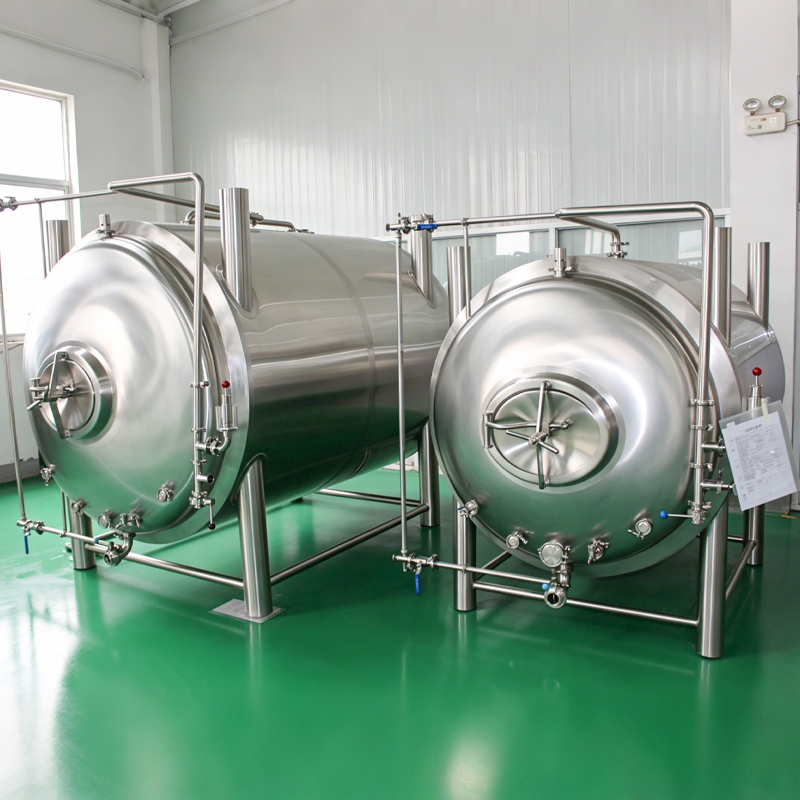
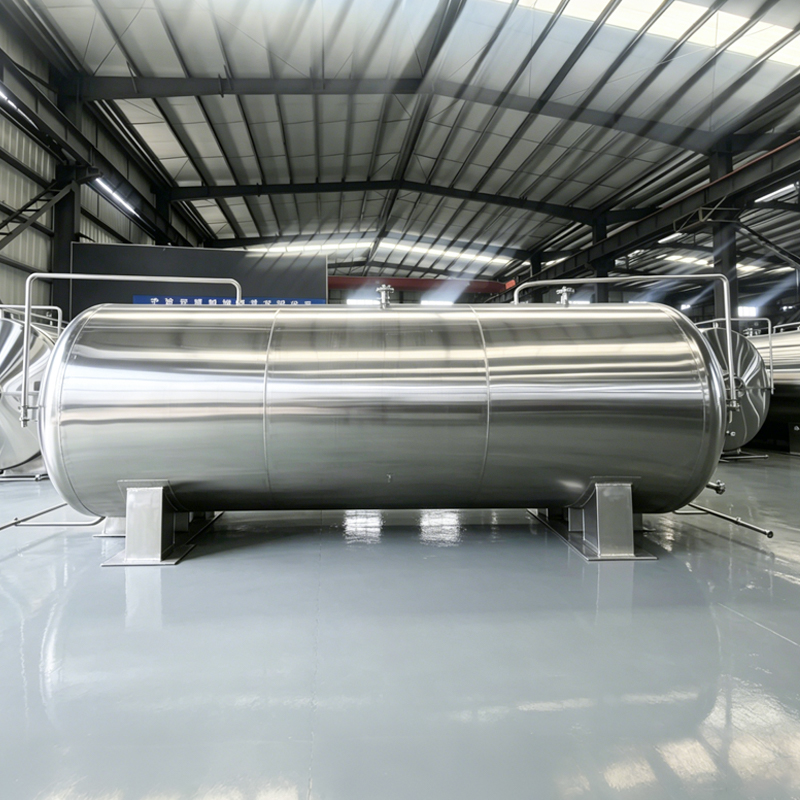
Horizontal Storage Tanks are cylindrical vessels mounted on saddle supports with the tank body lying on its side rather than standing upright. This low-profile orientation keeps the overall installed height well below that of a vertical tank of equal capacity, making horizontal tanks a practical solution for buildings with restricted ceiling clearance, outdoor yards, and mobile or skid-mounted processing units.
They are commonly used across breweries, dairies, and beverage plants to store water, beer, juice, and other liquid products that require intermediate holding between processing steps or during transport between facilities.
The horizontal orientation offers several practical benefits that make it a preferred choice in specific plant layouts and operating conditions.
- Low installed height — ideal for buildings with limited ceiling clearance or for outdoor sites where a tall vertical silhouette is undesirable
- Improved stability and lower center of gravity, reducing tipping risk in exposed or windy locations
- Easier road transport on flatbed trailers, since the tank's low profile fits within standard shipping height limits
- Straightforward top access along the full length of the tank for manway inspection and maintenance
- Simple integration into skid-mounted or modular processing units that need to be relocated between sites
How Horizontal Storage Tanks Work
Product enters through a top or end-mounted inlet and settles along the length of the cylindrical body. Because the tank lies on its side, drainage relies on a side or end-mounted outlet positioned at the lowest point of the curved shell rather than a center-bottom cone, which is the typical drainage method used in vertical designs.
A saddle support system distributes the tank's full liquid weight across two or more contact points along its length, and these supports are engineered to account for the load distribution of a cylinder lying on its side rather than standing on end. For temperature-sensitive products, an insulated or jacketed shell wraps around the tank body, and the jacket can be zoned along the tank's length for more even temperature control.
Support Structure and Load Distribution
Because the weight of a full horizontal tank is distributed unevenly across its saddle supports as fill level changes, support spacing and reinforcement rings are calculated to prevent shell deformation, particularly for tanks in the 10,000–50,000 liter range where uneven loading has a greater structural impact.
Where Horizontal Tanks Fit Best
Choosing a horizontal tank over a vertical one typically comes down to available headroom, mobility requirements, and how the tank will be transported or relocated. The table below summarizes common decision factors.
Common site conditions that favor a horizontal storage tank layout
| Site Condition |
Why Horizontal Fits |
Typical Application |
| Low ceiling clearance |
Reduced installed height fits under low roof structures |
Retrofitted or converted buildings |
| Frequent relocation |
Fits within standard trailer transport height |
Mobile or skid-mounted brewing units |
| Windy outdoor sites |
Lower center of gravity improves stability |
Outdoor water or bulk liquid storage |
| Ample floor space |
Larger footprint is not a limiting factor |
Warehouse-style storage yards |
Industry Applications and Manufacturing Expertise
Horizontal storage tanks are frequently specified for outdoor bulk water storage, mobile brewing and beverage skids, and facility retrofits where a building's existing roof height cannot accommodate a tall vertical tank. They are also a practical option for temporary or seasonal production capacity that needs to be relocated between sites.
As a China-based OEM/ODM manufacturer of fluid process and brewery equipment with over 20 years of industry experience, YME Equipment Co., Ltd designs and manufactures horizontal storage tanks suited to a wide range of layout and mobility requirements. YME's designers, engineers, and production staff continuously undergo advanced training to stay current with industry trends and hygienic design standards, allowing the company to adapt tank configurations to projects of varying size and complexity. YME's stainless steel equipment has been exported to customers across Europe, North America, Australia, and Asia, supported by long-term partnerships built on consistent product quality and precise, tailored engineering.
Frequently Asked Questions
Q1: Can horizontal storage tanks be moved between locations?
Yes, their low profile makes them well suited for flatbed trailer transport, which is why they are commonly used in mobile or skid-mounted processing setups that need to relocate between sites.
Q2: How is drainage handled without a cone bottom?
Horizontal tanks use a side or end-mounted outlet positioned at the lowest point of the curved shell, which achieves near-complete drainage without requiring a conical base.
Q3: Are horizontal tanks suitable for products with sediment or particulates?
They can handle light sediment with a properly positioned outlet, but vertical tanks with a steep cone bottom generally provide more complete drainage for heavier particulate loads.
Q4: What support structure do horizontal tanks require?
Horizontal tanks rest on two or more saddle supports along their length, with support spacing and reinforcement calculated based on tank diameter, length, and full liquid weight.



 English
 русский
 عربى
عربى