

 English
 русский
 عربى
In chemical processing, the slow dissolution of powders into liquids can significantly bottleneck production timelines. Our High-Speed Open-top Chemical Mixing Vessel is designed to eliminate this bot...
READ MORE
High Shear Mixing: How It Works, Types, and How to Choose the Right Mixer
Content
- 1 What Is High Shear Mixing?
- 2 How a High Shear Mixer Works
- 3 Types of High Shear Mixers: In-Tank, Inline, and Vacuum
- 4 High Shear Mixer vs Disperser, Homogenizer, and Colloid Mill
- 5 Where High Shear Mixing Is Used in Production
- 6 How to Select the Right High Shear Mixer
- 7 Integrating High Shear Mixing into a Complete Processing Line
You have probably seen a batch fail for reasons that are hard to explain: a lotion that separates after a week, a sauce that turns watery, or a pigment paste with fine agglomerates that no amount of stirring can remove. The common thread is that conventional agitators do not generate enough shear to control droplet size, dispersion, or particle distribution. High shear mixing closes that gap by using a rotor-stator head to apply intense mechanical force in a short time, creating the stable emulsions, suspensions, and fine dispersions that many food, beverage, cosmetic, pharmaceutical, and chemical processes depend on.
This guide explains what high shear mixing is, how the rotor-stator principle works, which configurations are available, and what you should check before buying a high shear mixer. If you are evaluating equipment for a new line or troubleshooting an existing one, the first conclusion is simple: the right high shear mixer gives you repeatable results only when it is matched to your viscosity, solids content, and target quality.
What Is High Shear Mixing?
High shear mixing is a mechanical process that uses a rotor rotating at high speed inside a closely spaced stator to create strong shear forces. Those forces break down droplets or agglomerates, pull powders into liquids, and produce a uniform mixture with a much finer texture than conventional stirring can achieve. The result is often described as an emulsion (liquid-in-liquid), a suspension (solid-in-liquid), or a dispersion (fine particles evenly distributed).
In practical terms, high shear mixing is used when you need:
- Stable emulsions with droplet sizes in the micrometre range
- Wet-out and dispersion of powders without fish-eyes or lumps
- Particle deagglomeration and size reduction for paints, inks, and chemical pastes
- Rapid preparation of thick or viscous products such as adhesives, creams, and pharmaceutical ointments
If you are not yet sure whether your application really needs high shear, it helps to review the basics of mixing tank design first because the vessel layout can influence how the mixer performs.
How a High Shear Mixer Works
All high shear mixers share the same core principle: a rotor with precision-machined teeth spins at high speed inside a stationary stator. The product is drawn into the rotor and forced through the stator openings, where it experiences intense mechanical and hydraulic shear.
The Rotor-Stator Shear Zone
The gap between the rotor and stator is small, usually from about 0.5 mm to 3 mm depending on the model. As the rotor turns, fluid accelerates in the clearance and is expelled at high velocity. That acceleration creates the shear rate that controls how finely droplets or particles are broken down.
Tip Speed versus Shear Rate
Tip speed is the linear velocity at the outer edge of the rotor. It is a more meaningful number than revolutions per minute (RPM) because it accounts for rotor diameter. A larger rotor at a lower RPM can produce the same tip speed as a smaller rotor at a higher RPM. Shear rate is approximated by dividing tip speed by the gap width. For this reason, minor changes in gap or rotor design can change the mixing result significantly.
| Parameter | Typical Range | What It Affects |
|---|---|---|
| Rotor tip speed | 10–50 m/s | Shear intensity and mixing time |
| Rotor-stator gap | 0.5–3 mm | Shear rate and particle size |
| Rotor diameter | 50–500 mm | Flow capacity and torque |
| Batch volume per pass | Depends on tank size | Recirculation time |
The table gives only an order-of-magnitude idea. Actual values must be defined by process testing, not by generic curves.
Types of High Shear Mixers: In-Tank, Inline, and Vacuum
There is no single high shear mixer that suits all products. The three most common build-ups are in-tank batch mixers, inline mixers, and vacuum mixing systems.
In-Tank High Shear Mixers
An in-tank mixer is mounted on top of a process vessel, either directly or through a support frame. It recirculates the liquid inside the tank through the rotor-stator head until the desired result is reached. This is a flexible configuration for small to medium batch sizes, frequent product changes, and recipes that benefit from extended mixing time.
Inline High Shear Mixers
An inline mixer works like a pump-around or continuous unit. Product enters one side of the mixing chamber and exits the other after a single pass or a controlled number of passes. Inline configurations are easier to integrate into continuous processes and often provide a more reproducible result because the dwell time is short and constant.
Vacuum Mixing and Emulsifying Tanks
Vacuum mixing tanks combine high shear mixing with a vacuum hood and, in many designs, a scraper agitator. The vacuum removes air from the product, which is critical for thick creams, ointments, battery slurries, and vacuum deaerated adhesives. If your product must be free of visible air bubbles, a vacuum emulsifying tank is usually the safer choice.
- Choose an in-tank mixer when batch sizes vary and recipes require flexible mixing time.
- Choose an inline mixer for continuous production or when a fast single-pass result is enough.
- Choose a vacuum system when air entrainment, foam, or long-term stability is a concern.
High Shear Mixer vs Disperser, Homogenizer, and Colloid Mill
High shear mixing is often confused with other mixers that produce fine particles. The differences matter because each technology has a different operating cost and result.
| Technology | Typical Result | Best Used For | Limitation |
|---|---|---|---|
| High shear mixer | Emulsions and dispersions down to about 1–10 µm | Wet-out, emulsification, deagglomeration | Not for true nano-scale grinding |
| High speed disperser | Rough dispersion, wetting of powders | Paints, inks, pre-mixing | Uses a blade, not a rotor-stator; larger droplets |
| High pressure homogenizer | Very fine droplets below 1 µm | Dairy, pharmaceutical emulsions | High energy consumption; needs pre-mix |
| Colloid mill / wet mill | Particle size reduction with grinding surfaces | Pastes, suspensions, fibrous products | Higher wear; harder to clean |
In practice, a high shear mixer is usually the first step in a process that also uses a homogenizer or mill for final refinement. For many liquid products, however, a well-designed rotor-stator mixer alone is enough to meet specifications.
Where High Shear Mixing Is Used in Production
High shear mixing appears across many industries, typically wherever formulations are harder to make than simply stirring them together. The table below summarises the main application groups.
| Industry | Typical Products | Why High Shear Helps |
|---|---|---|
| Food and beverage | Salad dressings, sauces, syrups, juice emulsions | Stable oil-in-water emulsions, shorter mixing time |
| Dairy and plant-based drinks | Yogurt mixes, milk drinks, nut milks | Fine particle suspension, improved mouthfeel |
| Cosmetics and personal care | Creams, lotions, toothpaste, sunscreens | Fine, air-free emulsions and stable texture |
| Pharmaceuticals and biotech | Ointments, vaccines, buffer solutions | Precise droplet size and GMP-compliant hygiene |
| Chemicals and coatings | Paints, pigments, adhesives, industrial emulsions | Deagglomeration, consistent viscosity and color |
For instance, a rotor-stator emulsifying tank is widely used in cosmetic and food plants to bring oil and water phases together in a stable emulsion. In chemical plants, the same principle prepares pigment pastes and cleaning agents. The common requirement is a controlled shear level that a plain agitator cannot deliver.
How to Select the Right High Shear Mixer
Before you request a quotation, define your process in numbers. The cheapest machine is rarely the most economical when it fails to meet particle size or cycle time requirements.
Start with These Process Parameters
- Viscosity of the continuous phase and the final product
- Solid content and particle size before and after mixing
- Batch size and required cycle time
- Operating temperature and sensitivity to heat
- Target droplet or particle size with a quantitative limit
- Cleaning method: CIP or manual washing
Sanitary Design and Compliance
For food, dairy, cosmetic, and pharmaceutical products, the mixer should be built with SS316L contact parts, mirror polishing, and no dead zones where product can accumulate. GMP lines also require documentation of surface finish and material certificates. A mixer that is hard to clean will eventually compromise product safety, no matter how good its mixing performance looks in a lab.
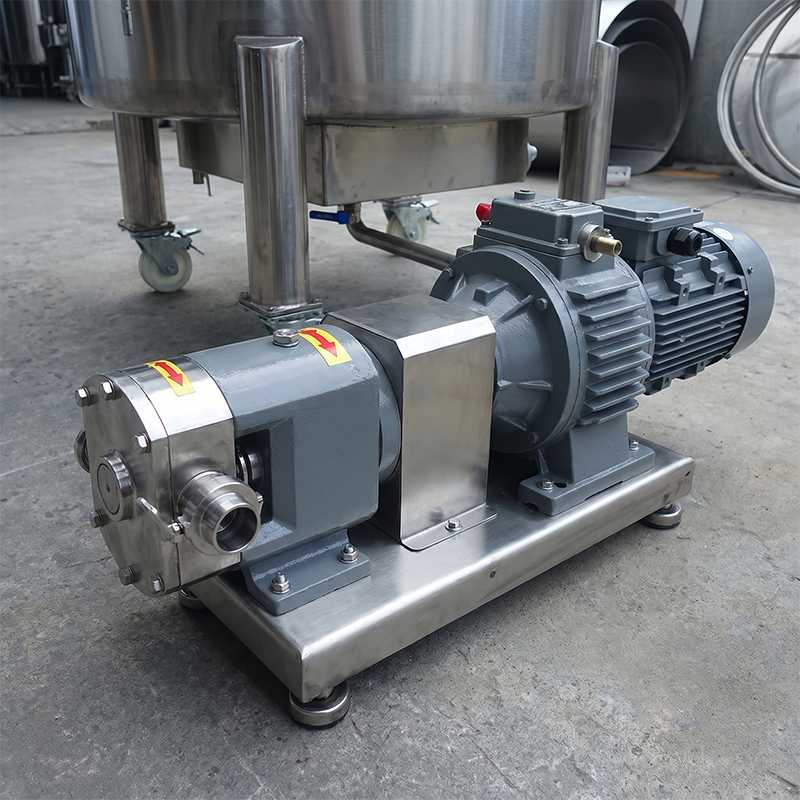 Aseptic Vacuum Mixing Tank with Anchor Scraper AgitatorThis tank operates under deep vacuum to remove air bubbles from ointments and creams, while its anchor scraper ensures complete heat transfer and prevents burn-on. Its sanitary design with no dead zones supports GMP compliance and easy cleaning for sterile products.View Product →
Integrating High Shear Mixing into a Complete Processing Line
High shear mixers do not operate alone. In a typical beverage or dairy line, the high shear tank works together with storage tanks, heating/cooling jackets, CIP systems, and pasteurizers. Understanding how the mixer will be controlled and cleaned is essential, especially when the line is automated.
For pigment and chemical production, the arrangement is simpler: a high shear tank with heating or cooling can replace several pieces of older equipment. A skid-mounted or tank-based design reduces installation time and makes the process easier to validate.
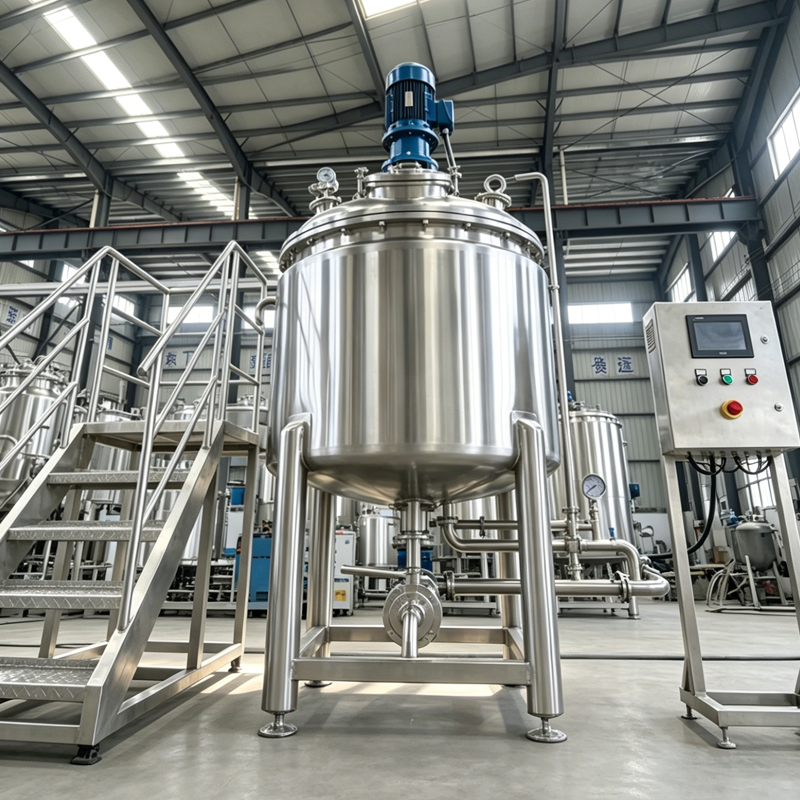 Industrial High Shear Mixer for Pigment and Paint GrindingDesigned for high-solid content dispersions, this mixer uses a toothed dispersion disc to break pigment agglomerates for consistent color. Its wear-resistant alloys and ex-proof standard make it suitable for abrasive coatings and chemical batches, reducing equipment needs.View Product →
High shear mixing is not a single piece of equipment; it is a process decision. Start with the product specifications, confirm the required droplet or particle size, and then choose a tank or inline configuration that matches your batch operation. The most reliable results come from testing your actual formulation with the actual machine geometry, not from comparing motor power alone.
If you are planning a new line or upgrading an existing one, it is worth discussing the full process with an equipment manufacturer that can supply tanks, mixers, and the controls around them. Contact us with your process parameters, and we can help you define a practical high shear solution.
News
-
-
Cleaning and discharging high-viscosity pastes from large vacuum tanks can be labor-intensive and hazardous. Our Automatic Lifting Vacuum Mixing Machine features a hydraulic lifting head that raises t...
READ MORE -
Scaling to multi-line production requires a CIP system that doesn't become a bottleneck. This high-efficiency system is designed with multiple independent loops, allowing the cleaning of one line whil...
READ MORE -
In advanced chemical synthesis, even a 2°C deviation from the target temperature can lead to batch failure. Our High-Precision Jacketed Agitator Tank is engineered for critical processes requiring mic...
READ MORE -
Standard mixing fails to break down oil droplets or solid agglomerates, resulting in unstable emulsions and grainy textures. Our 3000 RPM High Shear Emulsifying Tank solves this by utilizing a high-pr...
READ MORE -
In the paint and coating industry, pigment "clumping" leads to poor color development and surface defects. Our Industrial High Shear Mixer is specifically designed for high-solid content dispersions. ...
READ MORE
YME Equipment
-
Quick Links
Home Products About Solution Service News Contact -
Products Category
Mixing Tanks Storage Tanks Fermentation Tanks Brewing Equipment CIP Cleaning Systems Pasteurizers Beverage & Dairy Turnkey Solutions
-
-
Welcome To Visit Us
No. 15 Yinghua Road, Chengdong Industrial Park, Daxu Town, Xiangshan County, Ningbo City, Zhejiang Province, China -
Call Us
• Mob: +86 0574 6583 9268 -
Contact Us Online
• info@ymeequipment.com
Copyright © YME Equipment Co., Ltd. All Rights Reserved.
OEM/ODM Fluid Process Equipment Manufacturer
Brewery Equipment Supplier
