

 English
 русский
 عربى
عربىIn the paint and coating industry, pigment "clumping" leads to poor color development and surface defects. Our Industrial High Shear Mixer is specifically designed for high-solid content dispersions. ...
READ MORE
How Paint Is Manufactured: Step-by-Step Guide to the Paint Production Process
Content
A paint plant manager in Ningbo opened the previous week's production log and found a familiar problem: batch 2417 and batch 2418 used the same formula, the same pigment lots, and the same process records, yet the drawdown from batch 2418 showed lower color strength and a coarser grind. The problem was not the ingredients. It was the way the dispersion and let-down steps were executed.
Paint manufacturing is a controlled sequence of dispersion, blending, testing, and filling. A stable, consistent coating is achieved when each stage is carried out with the correct equipment and process parameters. This article explains how paint is manufactured in a typical commercial plant, which process stages matter most, and what mixing and storage equipment works best at each point.
Paint Manufacturing at a Glance: Four Controlled Stages
Whether a plant produces architectural paints, industrial primers, or automotive coatings, the production sequence follows the same structure. The four stages below appear in virtually every paint manufacturing process.
| Stage | Main Objective | Typical Equipment | Process Time |
|---|---|---|---|
| 1. Pigment dispersion | Break pigment agglomerates down to a target fineness | High-shear mixer, bead mill | 30-90 min |
| 2. Let-down | Add resins, solvents, and additives to reach final viscosity | Mixing tank with anchor or turbine agitator | 20-60 min |
| 3. Quality testing | Verify fineness, viscosity, and color strength | Hegman gauge, Brookfield viscometer | 15-45 min |
| 4. Filling and storage | Package finished paint and maintain its stability | Filling head, holding and storage tanks | Continuous |
The table above summarizes the overall flow. The sections that follow explain each stage in practical terms, with special attention to the equipment decisions that affect batch-to-batch consistency.
Stage 1: Pigment Dispersion
Pigments arrive at the paint plant as fine powders, but the primary particles are naturally clustered into agglomerates. In the delivered state, these clusters commonly measure 50-100 microns or more. In a finished paint, pigment particles normally need to be reduced to the 15-30 micron range, and sometimes finer for high-gloss finishes.
Dispersion is the mechanical process that breaks those agglomerates apart. It involves three things happening at once: wetting the pigment surface with the binder solution, applying shear to separate the clusters, and stabilizing the separated particles so they do not re-agglomerate during the rest of the process.
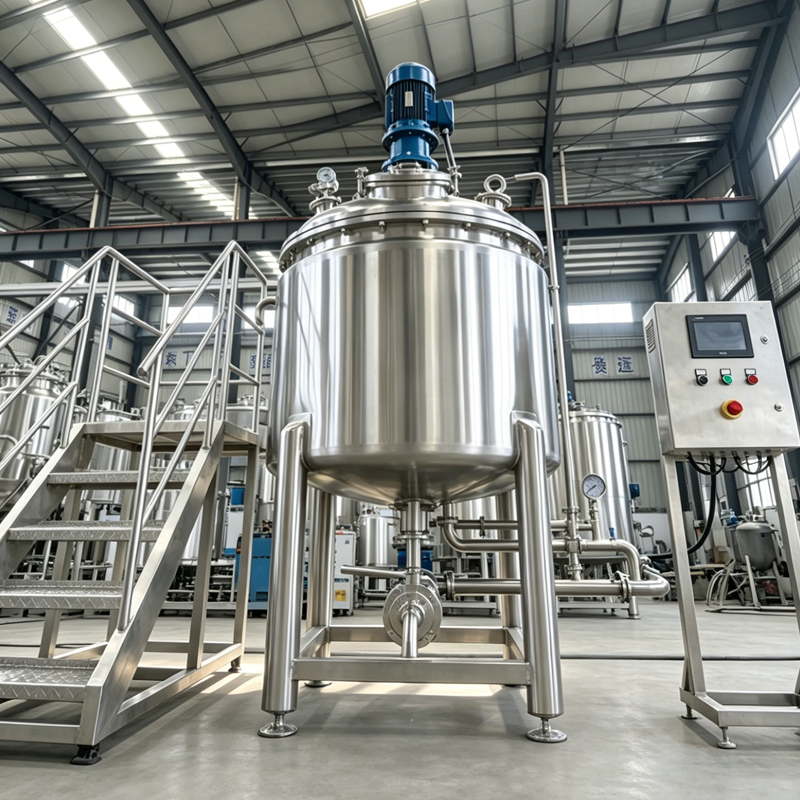 Industrial High Shear Mixer for Pigment DispersionThis mixer uses a high-torque motor and specialized dispersion disc to break pigment agglomerates, ensuring consistent color and smooth finish in high-solid-content paint and coating applications.View Product →
A rotor-stator mixer provides the mechanical energy needed for this step. The rotor spins at high speed inside a stationary stator, generating tip speeds of roughly 20-50 m/s. The slurry is drawn into the stator and expelled at high velocity, producing hydraulic shear and collision forces that split agglomerates into individual pigment particles.
For paint plants upgrading from simple paddle agitators to purpose-built dispersion equipment, a dedicated industrial high-shear mixer for pigment and paint grinding can shorten dispersion time from hours to minutes while producing a visibly more uniform mill base.
Typical dispersion parameters for a commercial paint batch
- Rotor tip speed: 20-50 m/s, depending on pigment hardness and binder system
- Batch temperature: keep below 50-60°C to limit solvent evaporation and resin degradation
- Dispersion time: 30-90 minutes per batch, verified with a Hegman gauge
- Fineness target: Hegman scale 6-7, corresponding to roughly 15-25 microns for most industrial paints
Stage 2: Let-Down and Blending
Once the pigment is fully dispersed, the concentrated mill base is transferred to a mixing tank. The remaining formula components are added here: resin solutions, solvents, defoamers, wetting agents, biocides, and thixotropic thickeners. This stage is called let-down, and it determines the final viscosity, flow behavior, and application properties of the paint.
The sequence in which ingredients are added matters. If the resin is poured in too quickly, localized precipitation can form small gels or specks that are difficult to re-disperse. A typical let-down sequence looks like this:
- Start the agitator at low speed and charge the mill base into the mixing tank.
- Add resin and plasticizer in a steady stream, not as a single pour.
- Introduce solvents slowly while watching the batch temperature to avoid boil-off.
- Blend in additives, with defoamers early in the cycle and thickeners near the end.
- Finish with a short homogenization pass to stabilize the dispersion before sampling.
Water-based paints are especially demanding during let-down. They are emulsions, which means excessive shear can break the droplets and destabilize the entire batch. An SS316L homogenizer tank for stable chemical emulsions gives the paint producer controlled shear at this stage, with enough flexibility to handle both low-viscosity and high-solids formulations.
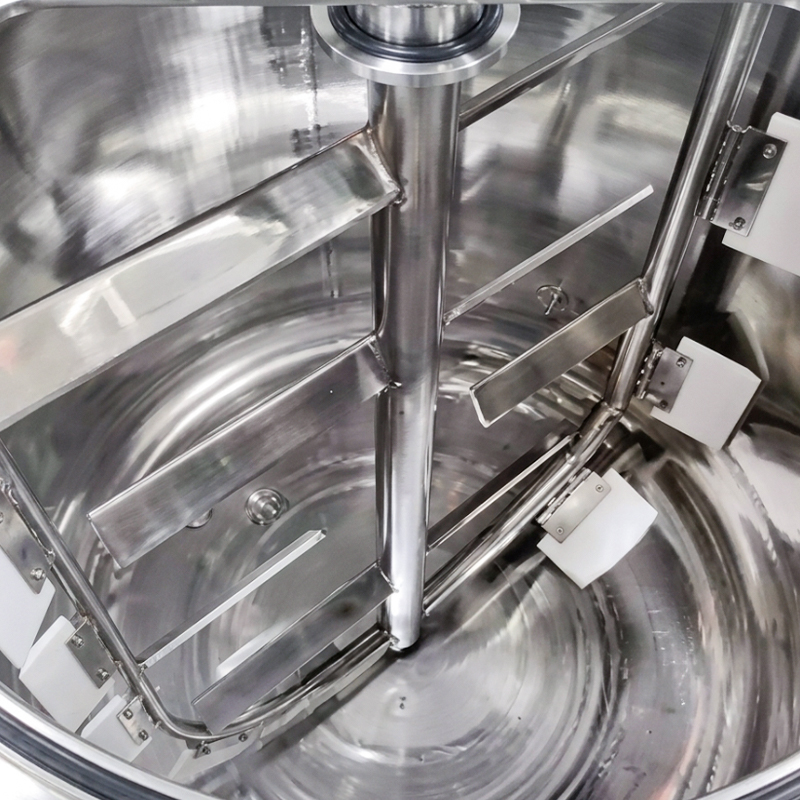 SS316L Homogenizer Tank for Reactive EmulsionsBuilt with corrosion-resistant 316L stainless steel and a high-performance homogenizer, this tank prevents metal contamination and suits demanding chemical blending, polymer modification, and high-purity processing.View Product →
The design of the mixing tank matters just as much as the agitation speed. Different agitator geometries create very different flow patterns, and the right configuration prevents dead zones where unmixed material collects near the tank bottom. For a practical overview of how mixing tanks work and which configurations suit different processes, see our article on what a mixing tank is.
Stage 3: Quality Testing
Before paint is sent to the filling line, every production batch must pass a small set of process control tests. These tests do not require a full analytical laboratory; they are designed to catch the most common batch defects in a few minutes.
- Fineness of grind: measured with a Hegman gauge. The target for industrial paints is typically 6-7, which corresponds to roughly 15-25 microns.
- Viscosity: measured with a Brookfield rotational viscometer. Liquid paints commonly range from 1 to 30 poise (100-3000 mPa·s) at 25°C.
- Density: confirms that pigment and binder ratios are within specification.
- Color strength: a drawdown is compared against an approved reference sample from the previous accepted batch.
- Drying time: a quick film drawdown check confirms that the cure profile has not shifted.
If a batch fails any of these tests, the usual corrective action is to return it to the let-down tank for a viscosity adjustment or an additional dispersion pass. Paint that fails on fineness of grind cannot simply be filtered; the particles will reappear after filtration, so the correct response is another pass through the high-shear equipment.
Stage 4: Filling and Storage
After quality approval, paint passes through a filter, typically 100 to 200 microns, and then moves to the filling line. The filling vessel must keep the paint gently agitated at all times. If pigments are allowed to settle, the first containers will be thinner than the last ones, and the entire batch will be judged defective even though it passed laboratory tests.
Finished paint is packaged in containers that range from 1-liter cans to 200-liter drums, or stored in tanks before shipment. Careful handling during filling preserves the consistency achieved earlier in dispersion and let-down.
Choosing the Right Equipment for Paint Manufacturing
When a plant expands capacity or switches from one paint family to another, for example from solvent-based industrial enamel to water-based architectural coating, the equipment lineup must be re-examined. The table below compares the three most common equipment choices in paint production.
| Equipment Type | Best For | Viscosity Range | Typical Batch Size |
|---|---|---|---|
| High-shear rotor-stator mixer | Pigment dispersion, mill base preparation | 100-50,000 mPa·s | 500-5,000 L |
| Homogenizer tank | Water-based paints, emulsion stabilization | 200-10,000 mPa·s | 200-3,000 L |
| Open-top mixing vessel | Let-down, general blending, small-batch flexibility | 50-5,000 mPa·s | 500-5,000 L |
For production lines handling solvent-based paints and medium-viscosity formulations, a variable-speed open-top vessel offers flexible blending capacity at a moderate capital cost. The high-speed open-top chemical mixing vessel is a practical example, designed to handle both dispersion and let-down tasks in a single tank.
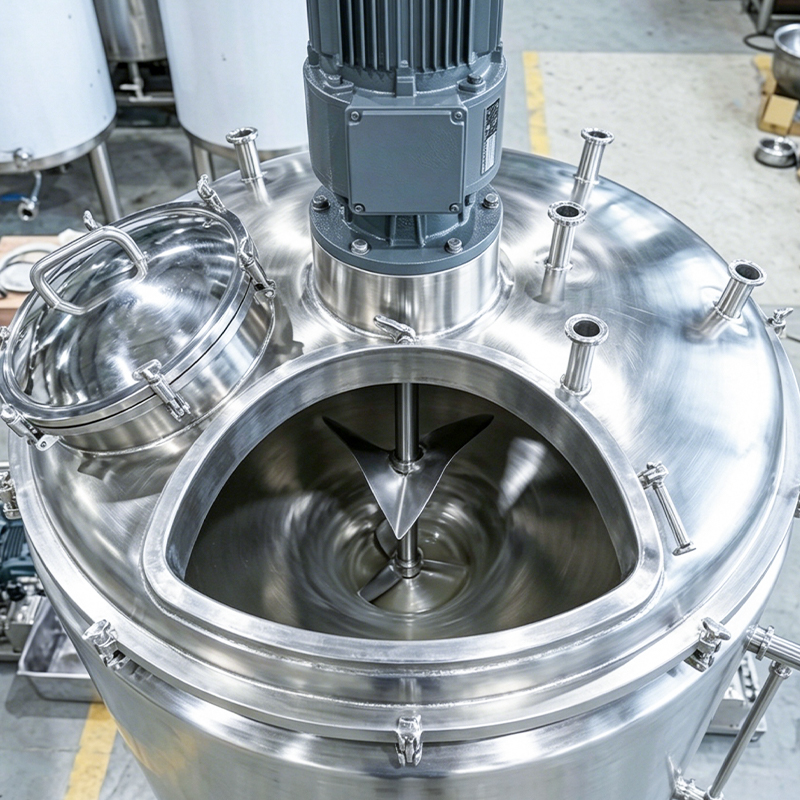 High-Speed Open-top Vessel for Chemical MixingFeaturing variable-speed impellers up to 960 RPM and an open-top design, this vessel rapidly incorporates powders and handles pigment dispersion and aggressive fluid mixing with reinforced construction.View Product →
Practical selection criteria
- Material of construction: SS304 is common for solvent-based paints; SS316L is preferred for water-based systems and chloride-containing additives.
- Jacketed heating or cooling: required when viscosity needs to be controlled during dispersion and let-down.
- Clean-in-place capability: reduces changeover time when switching between colors or product families.
- Tank capacity versus batch size: allow at least 15-20% headspace for solvent addition and shear-induced splashing.
- Speed control: variable-frequency drives allow one tank to move from low-shear blending to high-shear dispersion.
Paint manufacturing looks simple from the outside: mix pigment, resin, and solvent, then package the result. In practice, each stage, from dispersion and let-down to testing and filling, places different mechanical demands on the equipment. Batch consistency is decided less by the formula alone than by how well the mixing and dispersion equipment matches the pigment system, the viscosity range, and the production scale.
If you are planning a new paint production line, upgrading an existing plant, or adding dispersion capacity, it helps to discuss the process with an equipment supplier who can match tanks, agitators, and high-shear mixers to your specific formulations. Contact us to review your project requirements.
News
-
-
Scaling to multi-line production requires a CIP system that doesn't become a bottleneck. This high-efficiency system is designed with multiple independent loops, allowing the cleaning of one line whil...
READ MORE -
Consistency in yogurt production depends on precise incubation temperatures and a strictly sterile environment for culture inoculation. This end-to-end plant covers the entire process from base mix pr...
READ MORE -
Complex dairy and plant-based milk products require more than just heat; they need oxygen removal and particle reduction for long-term stability. This Integrated Aseptic Line combines a vacuum deaerat...
READ MORE -
In chemical processing, the slow dissolution of powders into liquids can significantly bottleneck production timelines. Our High-Speed Open-top Chemical Mixing Vessel is designed to eliminate this bot...
READ MORE -
Maintaining biological stability and achieving perfect carbonation in a single vessel is critical for modern craft brewing. This Unitank features independent dual-zone cooling jackets (cone and sidewa...
READ MORE
YME Equipment
-
Quick Links
Home Products About Solution Service News Contact -
Products Category
Mixing Tanks Storage Tanks Fermentation Tanks Brewing Equipment CIP Cleaning Systems Pasteurizers Beverage & Dairy Turnkey Solutions
-
-
Welcome To Visit Us
No. 15 Yinghua Road, Chengdong Industrial Park, Daxu Town, Xiangshan County, Ningbo City, Zhejiang Province, China -
Call Us
• Mob: +86 0574 6583 9268 -
Contact Us Online
• info@ymeequipment.com
Copyright © YME Equipment Co., Ltd. All Rights Reserved.
OEM/ODM Fluid Process Equipment Manufacturer
Brewery Equipment Supplier
