

 English
 русский
 عربى
عربىIn the paint and coating industry, pigment "clumping" leads to poor color development and surface defects. Our Industrial High Shear Mixer is specifically designed for high-solid content dispersions. ...
READ MORE
Industrial Mixer Preventive Maintenance Checklist: Daily to Yearly Tasks
Content
- 1 Why Preventive Mixer Maintenance Beats Crisis Repair
- 2 Daily Mixer Maintenance Checklist
- 3 Weekly Mixer Maintenance Tasks
- 4 Monthly Mixer Maintenance Checklist
- 5 High-Shear and Emulsifying Mixers Need Extra Care
- 6 Six Warning Signs That Require Immediate Attention
- 7 Build a Maintenance Log That Preserves Knowledge
- 8 When to Contact the Equipment Manufacturer
At 2:00 a.m., the high-shear emulsifier on line 3 seizes. The tank holds 3,000 liters of lotion base that is now scrap. Production stops for nine hours while a service technician replaces a bearing that had been humming for two months. This scenario repeats in dairy, beverage, and chemical plants every week, and it is almost always avoidable with a structured industrial mixer maintenance checklist.
Why Preventive Mixer Maintenance Beats Crisis Repair
An agitated tank looks like a simple stainless steel vessel, but the components inside its drive train — bearings, seals, shafts, and impellers — work under constant mechanical stress. A mixer that runs 16 hours a day accumulates wear that is invisible during a quick glance.
The cost gap is significant. Replacing a mechanical seal early costs a few hundred dollars in parts. Replacing the same seal after a catastrophic failure can involve re-grinding a shaft, replacing the impeller, and discarding an entire batch. Industry data shows that unplanned downtime typically costs three to five times more than the repair itself once lost production, labor, and raw materials are counted. A simple checklist flips the economics in your favor.
Daily Mixer Maintenance Checklist
Daily checks take about five minutes per mixer. The goal is not deep diagnosis; it is detecting change. Most developing failures announce themselves through noise, heat, or vibration long before they stop the machine.
- Visual walk-around: Look for oil leaks under the gearbox, weeping from the mechanical seal, loose belt debris, and dust accumulating on the motor housing.
- Listen for new noise: A knocking impeller or a whining gearbox signals that internal clearances have changed.
- Temperature touch test: Gearbox housings and motor casings should be warm but not uncomfortable to the touch. Sustained operation above 90°C indicates a problem.
- Vibration check: Place a hand on the motor mount and the tank nozzle flange. New buzzing or pulsing points to bearing wear or alignment drift.
- Product side observation: If a sight port exists, confirm the impeller is turning without visible wobble.
Operators are the best sensor system in the plant. A logbook where they note unusual sounds or readings often catches a problem weeks before an instrument does.
Weekly Mixer Maintenance Tasks
Weekly maintenance targets the components that wear progressively: lubrication, seals, and fasteners. Set a fixed weekday for these tasks so the rhythm becomes part of normal operations.
Lubrication and Seals
- Grease fittings: Most industrial mixers have two to four grease points on the motor bearings and the gearbox input shaft. Use the grease grade specified by the manufacturer; mixing different grease chemistries can damage seals.
- Mechanical seal inspection: A slow drip may be atmospheric condensate, but a steady spray or product buildup around the seal gland means the seal face is damaged.
Fasteners and Motor Cooling
- Torque check: Vibration loosens coupling bolts and tank nozzle flange bolts over time. Use a torque wrench and compare readings with the original specification.
- Motor cooling: Dust on the motor fins reduces cooling efficiency and shortens insulation life. Clean the exterior with compressed air or a soft brush.
Mixers that move between stations, such as a portable sanitary mixing tank with integrated VFD control, need extra attention in this weekly routine because their couplings, casters, and electrical connections see additional stress from repeated repositioning.
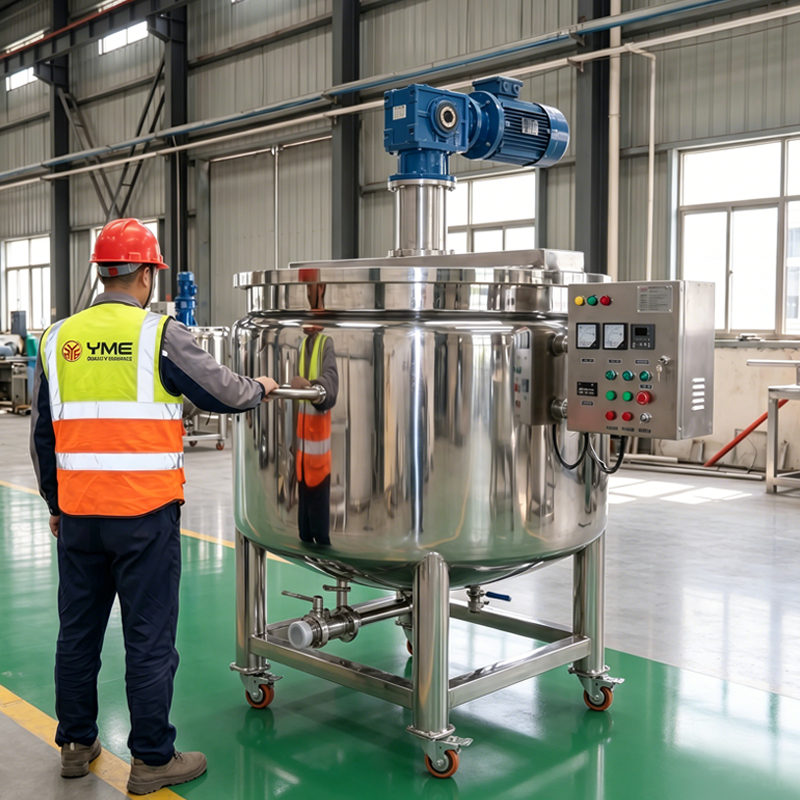 Portable Sanitary Mixing Tank with Integrated Control VFD Manufacturerr, Custom As a China Portable Sanitary Mixing Tank with Integrated Control VFD manufacturer and factory, YME Equipment Co., Ltd custom/OEM/ODM solu...View Product →
Monthly Mixer Maintenance Checklist
Monthly tasks require a short shutdown and go deeper than visual inspections. This is also the right moment to compare readings with last month's baseline and spot trends before they become problems.
| Inspection Point | Action | Acceptable Limit |
|---|---|---|
| Shaft alignment | Measure runout at the coupling with a dial indicator | Below 0.1 mm total indicated runout |
| Drive belts | Check tension and look for cracks or glazing | 10–15 mm deflection at mid-span |
| Gearbox oil | Check level and appearance; sample if milky or dark | Change every 3,000–5,000 operating hours |
| Impeller condition | Inspect for erosion, cracks, or weld failure | Replace if wall loss exceeds 20 percent |
Taking ten minutes each month to verify shaft alignment protects every other component in the drive train. A shaft running with only 0.5 mm of misalignment increases bearing load by up to 30 percent, which shows up later as premature seal failure and elevated vibration.
High-Shear and Emulsifying Mixers Need Extra Care
Rotor-stator mixers operate at far higher speeds than conventional agitators, which means they wear faster and demand tighter tolerances. The clearance between the rotor and the stator directly determines product quality. As the gap widens from wear, particle size distribution shifts and batches begin to fail specification.
For high-shear emulsifying tanks, check the rotor-stator gap monthly with feeler gauges, inspect the heads for pitting or erosion, and examine the mechanical seal for abrasive wear from recirculated product. A 3000 RPM high-shear emulsifying tank with rotor-stator system from YME Equipment uses replaceable wear parts, so the stator and rotor can be refreshed without removing the whole agitator assembly. Keeping spare rotor-stator sets on hand cuts repair lead time from weeks to hours.
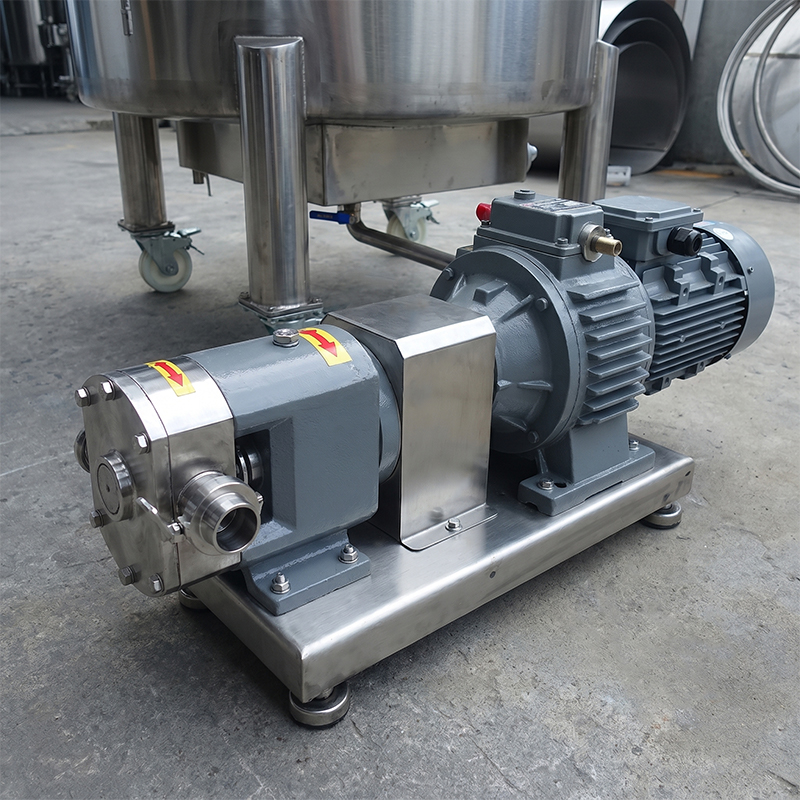 3000 RPM High Shear Emulsifying Tank with Rotor-Stator System Manufacturerr, CusAs a China 3000 RPM High Shear Emulsifying Tank with Rotor-Stator System manufacturer and factory, YME Equipment Co., Ltd custom/OEM/ODM ...View Product →
Six Warning Signs That Require Immediate Attention
Some symptoms are minor. These six are not. If any of them appears during a daily or weekly inspection, plan a shutdown and inspect the mixer before the next batch:
- Vibration above 7 mm/s on any axis indicates bearing or alignment failure.
- Gearbox temperature above 95°C without a recent oil change suggests overfilled oil, degraded lubricant, or imminent bearing failure.
- Visible crack or discolouration on the shaft near the coupling or seal area.
- Product leaking from the mechanical seal during operation, not just drips after shutdown.
- Unusual noise at startup that disappears after five minutes, often caused by a worn keyway or a loose impeller hub.
- Motor current above nameplate rating for more than 30 seconds indicates excessive load or internal binding.
Training operators to recognize these six signs is one of the highest-ROI maintenance investments a plant can make.
Build a Maintenance Log That Preserves Knowledge
Manuals get lost and tribal knowledge disappears when experienced staff retire. A simple maintenance log, whether paper or digital, keeps the history of every repair: when the seal was replaced, how often grease was applied, and how vibration readings trended over time.
For plants managing multiple mixers with different configurations, document what each machine is and what its failure history looks like. The overview of what is a mixing tank is a useful starting point for building a complete equipment register. A basic spreadsheet with columns for date, task, technician, reading, and parts used is enough for most plants with fewer than ten mixers. Larger operations should consider a CMMS that triggers tasks automatically and stores baseline readings for comparison.
When to Contact the Equipment Manufacturer
A maintenance checklist captures what you can see and measure. Some problems, however, are better diagnosed by people who build the equipment. If your mixer is still under warranty, or if you see cracks in welds, unexplained oil contamination, or progressively worse vibration that you cannot correct with alignment and tensioning, contact the manufacturer's after-sales team before attempting a disassembly you may regret.
YME Equipment's service support covers both the product side and the process side, which is valuable when mixers are integrated into a dairy, beverage, or CIP line. If an existing agitated tank is beyond economic repair, replacing it with a high-precision jacketed agitator tank with temperature control removes years of accumulated wear while adding thermal performance and process stability. Reach out through our contact page to evaluate whether repair or replacement makes more sense for your duty cycle.
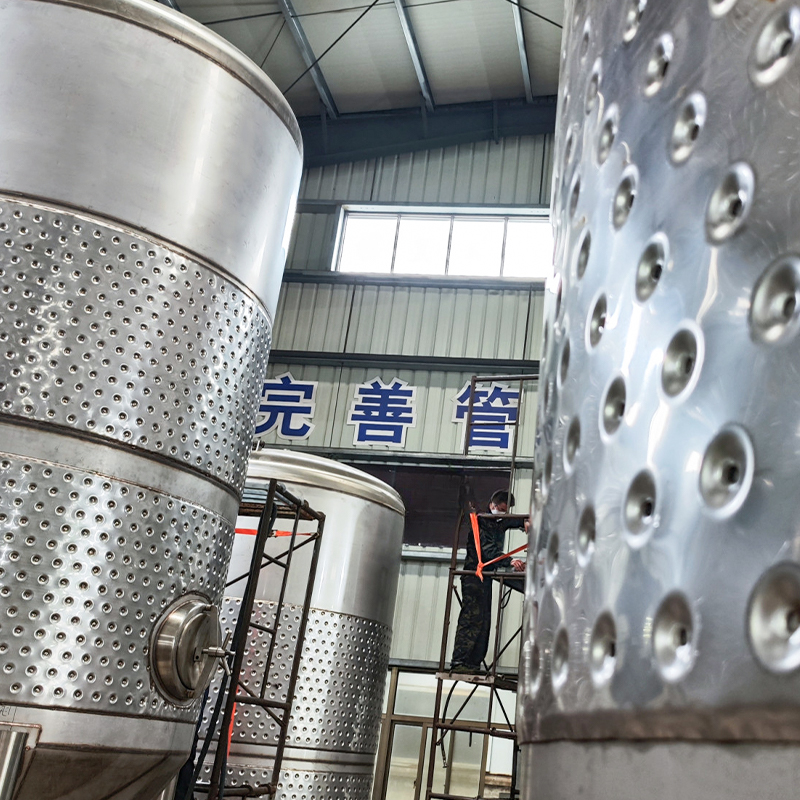 High-Precision Jacketed Agitator Tank with Temperature Control Manufacturerr, CuAs a China High-Precision Jacketed Agitator Tank with Temperature Control manufacturer and factory, YME Equipment Co., Ltd custom/OEM/ODM...View Product →
An industrial mixer maintenance checklist is not a static document. It evolves as your equipment ages, as your product formulations change, and as your maintenance team learns which failure modes are most common in your process. What matters is consistency. A five-minute daily inspection, a monthly alignment check, and a logbook that records all of it will keep your mixers running longer and more predictably than any expensive refurbishment program. The most expensive mixer in your plant is the one that stops on the night shift.
News
-
-
Bulk chemical logistics require a heavy-duty backbone that ensures safety and stability for massive volumes of industrial acids and solvents. These Industrial Capacity Silos are engineered with reinfo...
READ MORE -
Scaling production to industrial volumes requires vessels that can withstand massive hydrostatic pressure without compromising sanitary standards. Our Industrial Beer Fermentation Vessels are engineer...
READ MORE -
The primary pain point in industrial batching is the residue left in flat-bottom tanks, which leads to cross-contamination and excessive water waste during cleaning. Our Conical Bottom Vertical Tank i...
READ MORE -
In chemical processing, the slow dissolution of powders into liquids can significantly bottleneck production timelines. Our High-Speed Open-top Chemical Mixing Vessel is designed to eliminate this bot...
READ MORE -
In regulated industries, if a cleaning cycle isn't recorded, it didn't happen. This system features advanced data logging, recording temperature, conductivity, and flow data for every second of the cl...
READ MORE
YME Equipment
-
Quick Links
Home Products About Solution Service News Contact -
Products Category
Mixing Tanks Storage Tanks Fermentation Tanks Brewing Equipment CIP Cleaning Systems Pasteurizers Beverage & Dairy Turnkey Solutions
-
-
Welcome To Visit Us
No. 15 Yinghua Road, Chengdong Industrial Park, Daxu Town, Xiangshan County, Ningbo City, Zhejiang Province, China -
Call Us
• Mob: +86 0574 6583 9268 -
Contact Us Online
• info@ymeequipment.com
Copyright © YME Equipment Co., Ltd. All Rights Reserved.
OEM/ODM Fluid Process Equipment Manufacturer
Brewery Equipment Supplier
